Highlighted text? Practice this concept. Highlighted passages and figures open related questions.
Practice related questions (2)Progress & bookmarks
Current section
2-2-3 Resolution Process
p. 358
Practice this section 2 linked exam questions with default filters
Progress
Not marked complete
Related questions in this lesson 3
Incident and service request management2Checking known incidents and resolutions1Problem prevention and root causes1p. 358 · PDF 364
2-2-3 Resolution Process
Resolution process is a group of processes for the service recovery through quick response and the prevention of recurrence when events occur that hinder the delivery of service.
[Group of processes of resolution process]
1) Incident and service request management
2) Problem management
(1) Incident and service request management
In incident and service request management, incident handling or service requests handling is performed in order to recover the services as quickly as possible that are agreed on with the customer. The incident is an event or episode that adversely affects the service. Apart from a fault in the system (e.g., hardware, software) that delivers the service, a human error and violation of operation rules are also incidents. For example, when the operations department enters sales slips that are prepared by the sales department, if the data entry operator corrects errors in sales slips on the basis of his/her own judgment, it amounts to a man-made incident. (In this case,
p. 359 · PDF 365
1) Recording Recording (i.e., documenting) information of an incident (and service request).
2) Allocation of priority Prioritizing response taking into consideration the impact and urgency of incident.
3) Classification Categorizing the incident (There are cases where it is conducted immediately after recording.)
(2) Problem management
p. 360 · PDF 366
1) Identification and recording In order to identify a root cause and potential preventive action, the cause of occurrence (e.g., unresolved risk, vulnerability) of an incident is identified and recorded.
2) Allocation of priority Prioritizing of response is taken into consideration, and the impact and urgency of the problem are set.
3) Classification The problems are categorized. (There are cases where it is conducted immediately after identification and recording.)
4) Escalation The fundamental resolution of a problem is identified according to an appropriate escalation procedure. When the resolution requires changes, a request for change is submitted. (The actual changes are carried over in change management and release and deployment management.)
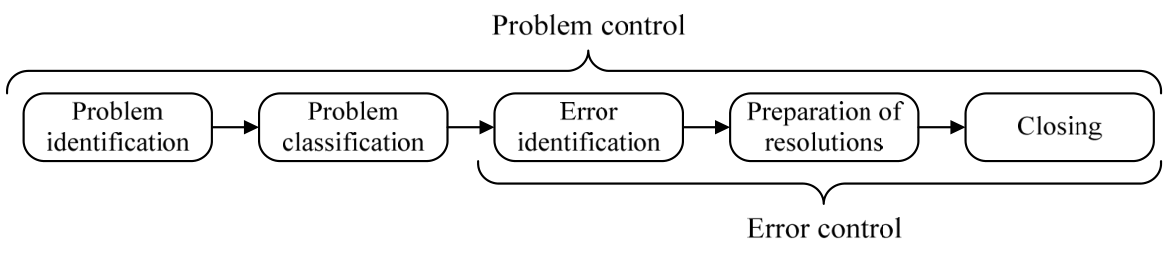
Records are made concerning the problems and their resolutions that are identified with a series of processes as known errors in KEDB (Known Error Database). The known error database must be managed in the accessible state for checking whether or not an incident is a known incident in the incident and service request management process. In this manner, the latest information concerning known errors and problem resolutions that have come to light with problem management is continuously provided to the incident and service request management process. Also, after implementation of resolutions, it is necessary to monitor and evaluate effectiveness of problem resolution and also review and report it. In this case, if it is determined that the resolution is not effective as a means of problem resolution, a new resolution must be considered. There is also a concept that problem management is composed of “problem control” that controls the overall situation and “error control” that identifies the resolution of an error.
Source visual description
Five rounded boxes are connected left to right by arrows: Problem identification, Problem classification, Error identification, Preparation of resolutions, and Closing. The upper brace labeled Problem control spans the full sequence. The lower brace labeled Error control spans Error identification through Closing.
Original visual text
Figure 6-3 Problem control and error control
Section progress
Original chapter exercises
Original chapter exercises →New FE Textbook Vol.2 · First Edition, April 2015