Highlighted text? Practice this concept. Highlighted passages and figures open related questions.
Practice related questions (1)Progress & bookmarks
Current section
1-3 ITIL
p. 346
Practice this section 1 linked exam question with default filters
Progress
Not marked complete
Related questions in this lesson 2
Service life cycle2p. 346 · PDF 352
1 - 3 ITIL
ITIL (Information Technology Infrastructure Library) is a guidebook that systematically summarizes the best practices for efficiently delivering and managing IT services. Its contents have become the de facto standard of IT service management.
(1) ITIL v2
ITIL v2 is composed of two books of service support and service delivery that were released in the beginning of 2000, which contains the collection of books of ITIL published since 1998.
p. 347 · PDF 353
[Structure of ITIL v2]
- • Service support
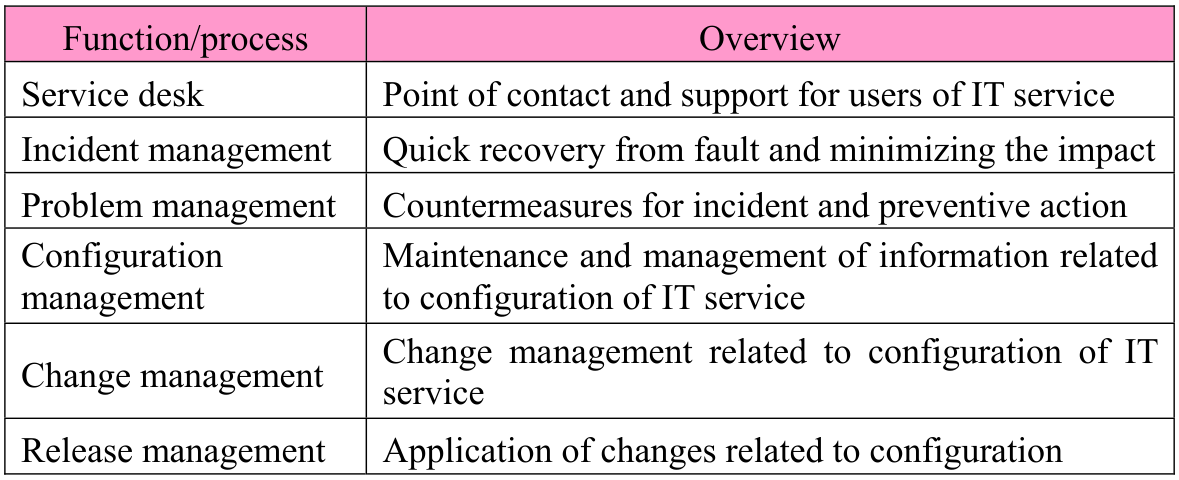
It refers to day-to-day operations management that is performed for the entire IT service. Service support is composed of one function and five processes.
| Function/process | Overview |
|---|---|
| Service desk | Point of contact and support for users of IT service |
| Incident management | Quick recovery from fault and minimizing the impact |
| Problem management | Countermeasures for incident and preventive action |
| Configuration management | Maintenance and management of information related to configuration of IT service |
| Change management | Change management related to configuration of IT service |
| Release management | Application of changes related to configuration |
- • Service delivery
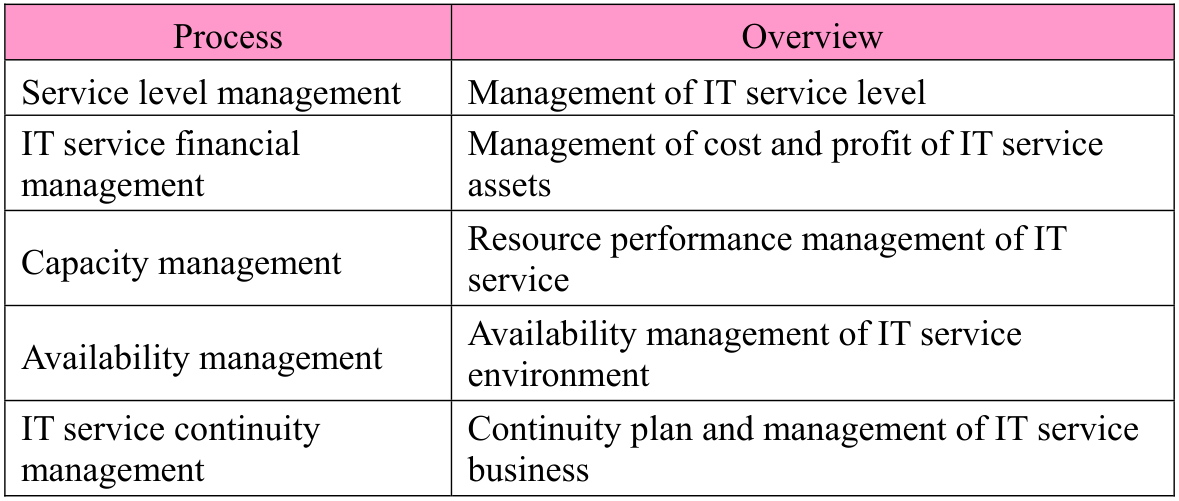
It refers to medium- and long-term operations management of overall IT service between the IT service provider and the customer, in which the business strategy is considered. Service delivery is composed of five processes.
| Process | Overview |
|---|---|
| Service level management | Management of IT service level |
| IT service financial management | Management of cost and profit of IT service assets |
| Capacity management | Resource performance management of IT service |
| Availability management | Availability management of IT service environment |
| IT service continuity management | Continuity plan and management of IT service business |
(2) ITIL v3
ITIL v3 is service management that is systematically organized from the standpoint of service life cycle in 2007. (It was updated to ITIL 2011 edition in 2011.)
p. 348 · PDF 354

Source visual description
Five original boxes are connected by right-pointing arrows in this order: Strategy, Design, Transition, Operation, Continual improvement.
Original visual text
Figure 6-1 Service life cycle
[Structure of ITIL v3]
- • Service strategy (strategy)
The service provider decides the policy of the organization and the goals to be achieved related to the service. - • Service design (design)
The service provider prepares the contents, operation method, and transition plan of the service. - • Service transition (transition)
The service provider implements a new service or modifies the existing service. - • Service operation (operation)
The service provider operates the service and delivers value to the customer. - • Continual service improvement (continual improvement)
The service provider applies the PDCA cycle and improves the service.
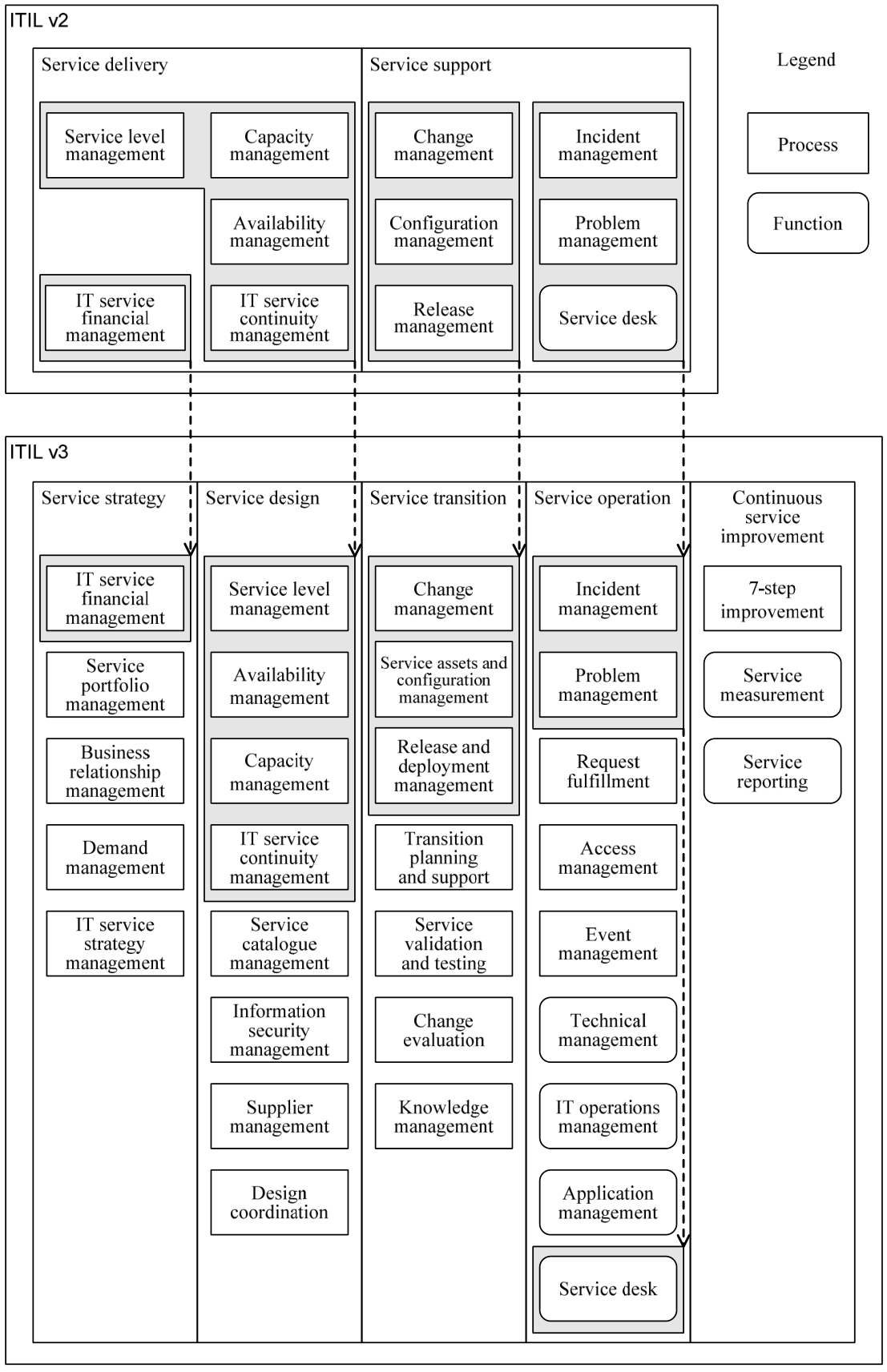
Correspondence between ITIL v2 and ITIL v3 is as shown below. Roles of the processes, which have identical (or almost identical) names in ITILD and ISO/IEC 20000 (JIS Q 20000), can be considered to be almost the same.
p. 349 · PDF 355
Source visual description
The upper ITIL v2 frame has two groups. Service delivery contains Service level management, Capacity management, Availability management, IT service financial management, and IT service continuity management. Service support contains Change management, Incident management, Configuration management, Problem management, Release management, and Service desk. Below, the ITIL v3 frame has five columns. Service strategy contains IT service financial management, Service portfolio management, Business relationship management, Demand management, and IT service strategy management. Service design contains Service level management, Availability management, Capacity management, IT service continuity management, Service catalogue management, Information security management, Supplier management, and Design coordination. Service transition contains Change management, Service assets and configuration management, Release and deployment management, Transition planning and support, Service validation and testing, Change evaluation, and Knowledge management. Service operation contains Incident management, Problem management, Request fulfillment, Access management, Event management, Technical management, IT operations management, Application management, and Service desk. Continuous service improvement contains 7-step improvement, Service measurement, and Service reporting. Dashed arrows connect the v2 financial-management box to v3 financial management, the other four delivery processes to their v3 Service design group, the Change/Configuration/Release group to its v3 Service transition group, and the Incident/Problem/Service desk group to the corresponding v3 Service operation boxes. The legend identifies rectangular boxes as Process and rounded boxes as Function. Rounded function boxes are the v2 Service desk; v3 Technical management, IT operations management, Application management and Service desk; and v3 Service measurement and Service reporting.
Original visual text
Figure 6-2 Correspondence between ITIL v2 and ITIL v3
Section progress
Original chapter exercises
Original chapter exercises →New FE Textbook Vol.2 · First Edition, April 2015