Highlighted text? Practice this concept. Highlighted passages and figures open related questions.
Practice related questions (1)Progress & bookmarks
Current section
2-3 Operation of Service
p. 365
Progress
Not marked complete
Related questions in this lesson 1
Service-desk response procedure1p. 365 · PDF 371
2 - 3 Operation of Service
Operation of service refers to day-to-day activities that are conducted for delivering the service to the customer. Service is operated with system operations management for maintenance and improvement of system operations to deliver service, service operation for conducting stable operation of the system, and service desk, which is a point of contact for the customer.
2-3-1 System Operations Management
In system operations management, the following are managed according to various plans: resources and facilities that are required for operating the system, fault, security, or cost of the system.
[Plans used in system operations management]
- • Daily operation plan
- • Plan for conducting appropriate operation at the occurrence of a fault
- • Improvement plan for reducing operation load, etc.
Daily operation plan is a plan that an operations management representative issues after checking and approving the contents of the plan, and it corresponds to the design document for system operation. The operation plan contains a detailed description of operations management rules, operational procedure, responsible personnel, annual operation plan, maintenance procedure, and so on. The following operations management activities are conducted on the basis of the operation plan.
- • Resource management of operations
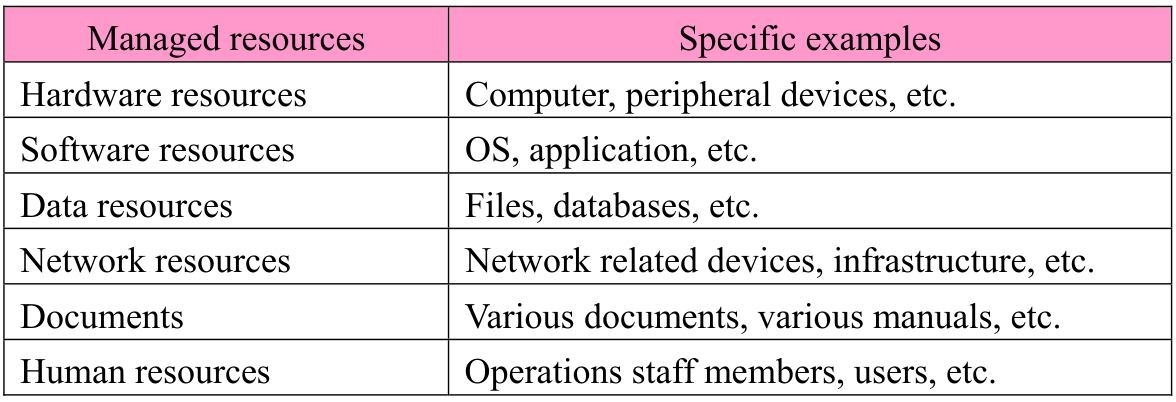
The resources that are required for system operation are maintained and managed so that it conforms to the targets of the organization.
| Managed resources | Specific examples |
|---|---|
| Hardware resources | Computer, peripheral devices, etc. |
| Software resources | OS, application, etc. |
| Data resources | Files, databases, etc. |
| Network resources | Network related devices, infrastructure, etc. |
| Documents | Various documents, various manuals, etc. |
| Human resources | Operations staff members, users, etc. |
- • Job management
The jobs are launched in an appropriate order (or monitor that they are automatically
p. 366 · PDF 372
executed in an appropriate order) and managed so that each job operates normally.
Virtual environment operations management that uses cloud computing or SOA (Service Oriented Architecture) needs to be planned and managed in a similar manner. In addition, operations management includes activities that are undertaken on the basis of the policies of capacity management, information security management, and service continuity and availability management of the service management processes.
2-3-2 Operation
In an operation, a system is operated according to the operation procedure that is defined in the operations manual or such other document, and the operation status of system is monitored and then reported periodically.
(1) System operations
System operations must be basically conducted according to the work instructions that are described in operations manual or such other document. Therefore, for preparing an operation plan, schedule design becomes important in terms of what kind of activity should be performed when and how. In particular, with regard to jobs such as backup after completion time of service delivery, it is necessary to prepare job scheduling for completing before the starting time of service delivery.
[Types of backups]
- • Full backup
This copies all data. - • Differential backup
This copies all data that is updated after the previous full backup. - • Incremental backup
This copies only data that is updated after the previous backups (i.e., full backup and incremental backups).
In addition, plans for appropriate operation at the occurrence of a fault are also important, such as recovery and rerun methods in the event of unsuccessful job execution and a restore procedure (i.e., data recovery procedure) using backup files in the event of loss of data because of a fault or such other error.
p. 367 · PDF 374
(2) System monitoring
System monitoring is conducted for early detection of system defects and for proposing improvements in system quality and solutions to problems. For that, it is required to utilize output management, such as managing the forms and the log information that are generated from the system and operations support tools (monitoring tools, diagnostic tools). In addition, it is also required to use the client monitoring tool, which is one of the operations support tools, and monitor the status of a client. For example, the inventory collection function is used to inspect that any non-business related software is not installed, and the software distribution function is used to update the antivirus software (or virus definition file) to the latest state. In this manner, it is also important to maintain the system in the appropriate state by also monitoring the client. While it is good to identify the reasons for decline in performance to propose improvements by monitoring the system, the operations department should not change the system or configuration devices on the basis of its own decision.
2-3-3 Service Desk
Service desk is a SPOC (Single Point Of Contact) for inquiries (e.g., communication of fault, service request, complaint) from the service user (i.e., customer). The service desk offers convenience of service by responding to the inquiries from the users.
[Classification of service desk on the basis of the functions offered]
- • Service desk
It acts as the reception for the overall service and is provided with primary response functions. - • Help desk
It acts as the reception for specific fields (or service) and is provided with primary response functions. - • Call center
It is only provided with the reception function for the overall service. CTI (Computer Telephony Integration) with telephone integrated in the system is also used.
[Classification of service desk on the basis of structured form]
- • Central service desk
In this form, the service desk is consolidated in one place. - • Local service desk
In this form, a service desk is established in each user location.
p. 368 · PDF 375
- • Virtual service desk
In this form, multiple service desks work in collaboration and act as one service desk. There is another form called follow the sun that supports the user all over the world with regional service desks in different standard time zones.
The following is the general response procedure of service desks. The basic response procedure is documented as response manual.
1) Reception and recording The following are recorded here: the contents of inquiry, date and time, and name and contact details of the inquiring person.
3) Recording of the results of handling The process of how the inquiry was addressed is recorded. Even for an inquiry that could not be handled by the service desk, if possible, after a report is received from the department that dealt with the inquiry, handling process is recorded. On the basis of these records of handling, by preparing, publishing, and distributing FAQ (Frequently Asked Questions) containing common questions and their answers, the number of similar inquiries can be reduced.
Section progress
Original chapter exercises
Original chapter exercises →New FE Textbook Vol.2 · First Edition, April 2015