Highlighted text? Practice this concept. Highlighted passages and figures open related questions.
Practice related questions (3)Progress & bookmarks
Current section
2-4 Project Cost Management
p. 325
Practice this section 3 linked exam questions with default filters
Progress
Not marked complete
Related questions in this lesson 4
Function-point estimation3Function-point function types1COCOMO software size estimation1p. 325 · PDF 329
2 - 4 Project Cost Management
The purpose of project cost management is to clarify and control the budget spending plan for completing the project within the defined budget. The following processes are implemented for setting up and controlling the budget spending plan.
| Process groups | Process to implement |
|---|---|
| Initiating | – |
| Planning | [Plan cost management] |
| Estimate costs | |
| Develop budget [Determine budget] | |
| Implementing [Executing] | – |
| Controlling [Monitoring and controlling] | Control costs |
| Closing | – |
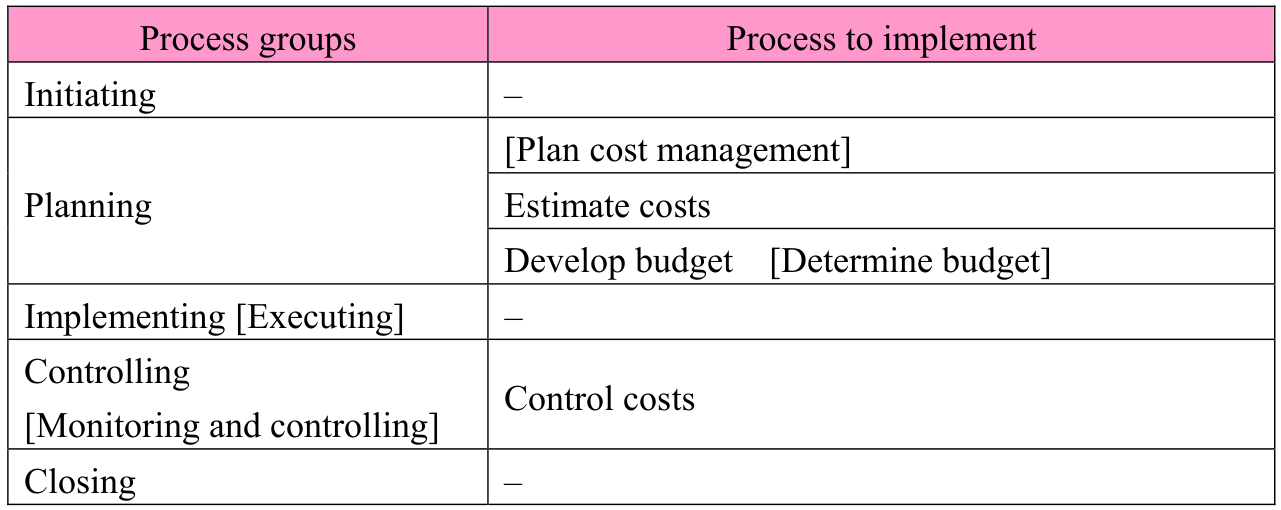
Note: The terms enclosed in brackets [ ] are used only in PMBOK.
p. 326 · PDF 330
(1) Cost management plan
This process creates a cost data format (e.g., the effective number of digits, measurement unit, control threshold) and a cost management plan that describe the performance measurement method, on the basis of the overview of the overall budget that is described in the project charter (budget summary), and on the basis of the project management plan and the subsidiary plans.
(2) Cost estimate
The cost required for executing each activity is estimated. As compared with the approximation of the cost calculated initially, the accuracy of cost estimate improves with the progress of the project. (In PMBOK, the estimate accuracy during the initiating stage is between −25% and +75%, and the estimate accuracy during the stage when the detailed information is collected is between −5% and +10%.) The main item of project cost management is the cost necessary for completing the project activities, but it is desirable to take into consideration the cost that arises after the project ends. For example, in the case of a system development project, not only the cost of development, but also the TCO (Total Cost of Ownership), including the cost of operations/maintenance after system installation and the cost of staff member training, must be taken into consideration. Cost estimate involves the use of techniques, such as analogous estimate, parametric estimate, three-point estimate, and reserve analysis. In analogous estimate, the differences
in the work package and activities that are refined stepwise are reflected on the basis of the performance of a similar project in the past. Therefore, it is also called top-down estimate. In contrast, there is bottom-up estimate, such as integration method in which the cost of the work package and activities keeps on adding up.
The other cost estimate techniques include the following. These techniques are also used in the activity duration estimate.
- • COCOMO (COnstructive COst MOdel)
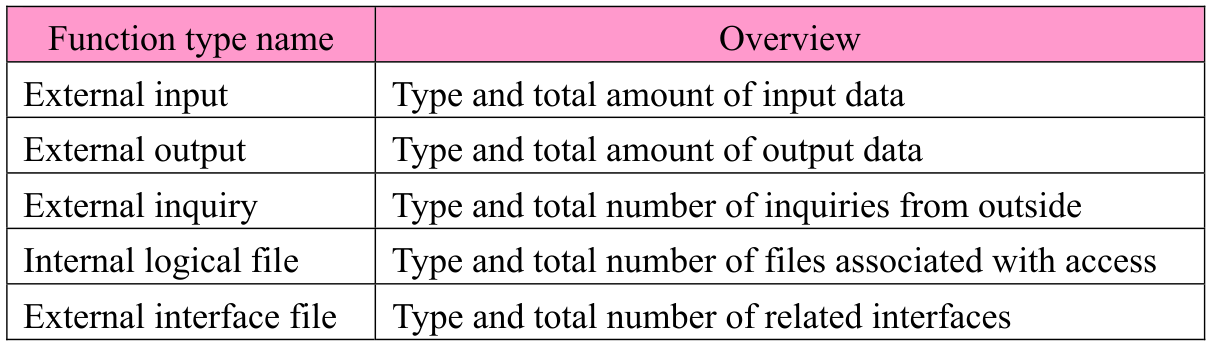
It is a technique of estimating the development cost and the development man-hours by calculating the workload (i.e., development productivity) of the programmers through a statistical model on the basis of the software development size (e.g., the number of program steps). The statistical model includes elements such as the estimation target level (e.g., overview, regular, detailed) and the composition of work force (e.g., single experts group, common group, mixed group). Currently, there has been a shift to COCOMOII. · 1 question - • FP (Function Point) method
This is a technique of estimating the development cost and the development man-hours with the help of the software functions that are obtained from the number of screens
p. 327 · PDF 331
| Function type name | Overview |
|---|---|
| External input | Type and total amount of input data |
| External output | Type and total amount of output data |
| External inquiry | Type and total number of inquiries from outside |
| Internal logical file | Type and total number of files associated with access |
| External interface file | Type and total number of related interfaces |
- • LOC (Lines of Code) method
This is a technique of estimating the development cost and the development man-hours on the basis of the number of lines of the source code of the software to be developed, the file size, and so on.
- • Standard task method
This is a technique of estimate in which the software development activities are broken down into standard activities, and the points (e.g., the man-hours and the cost) defined in each standard activity are integrated. - • Putnum model
This is a model that takes into consideration the time series variation in the development man-hours, and is a technique of estimate in which the development cost and the development man-hours are estimated from the performance data of a past development project.
(3) Development of budget
This process creates a budget spending plan including the cost of resources as a cost baseline on the basis of the result of cost estimate. Since a cost baseline is represented as a graph in which the estimation cost is deployed in time series and built-up, the baseline generally results
in an S-curve. During cost control, variance analysis is performed on the basis of EVM with the cost baseline as the reference, and the development productivity and the percentage of cost budget spent are managed. If the difference concerning the cost baseline is too great, it is necessary to consider changing the cost baseline to a realistic standard.
Section progress
Original chapter exercises
Original chapter exercises →New FE Textbook Vol.2 · First Edition, April 2015