CHAPTER 5
Project Management
View chapter contents →Highlighted text? Practice this concept. Highlighted passages and figures open related questions.
Practice related questions (1)Progress & bookmarks
Current section
1 Project Management Overview
p. 310
Practice this section 1 linked exam question with default filters
Progress
Not marked complete
Related questions in this lesson 9
Project life cycle and staffing1Purpose and contents of a project charter1Work Breakdown Structure3Project scope management1Scope creep2Scope monitoring and change control1Original project stakeholder definition1p. 310 · PDF 314
1 Project Management Overview
A project refers to fixed-term activities that are initiated irregularly in order to produce or provide a unique product or service. Project management refers to the management (i.e., control and administration) carried out in order to lead a project to its success.
1 - 1 Objective and Concept of Project Management
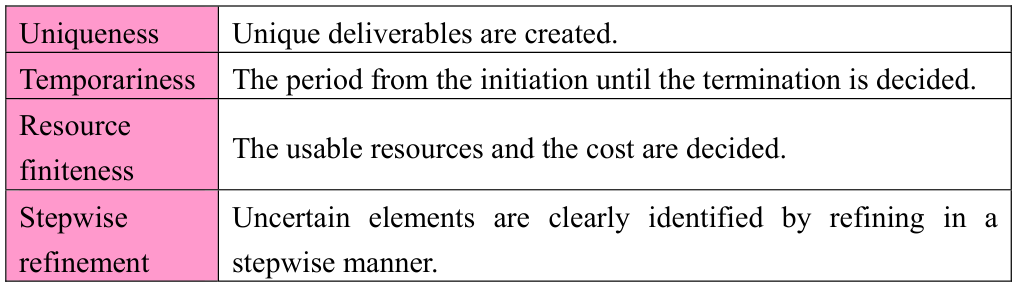
The purpose of project management is to meet the requirements of the project and lead it to its success. For this, in addition to knowledge, skills, and tools, techniques that make use of these are employed, and management is performed through a PDCA cycle that involves planning (Plan), proceeding (Do) with activities according to the plan, verifying the differences between the plan and actual result, and taking action (Act) against the cause of differences. A project has the following constraints, and its characteristics are summarized as shown in the table below.
[Project constraints]
| Quality | Quality standards that the project and the deliverables are required to meet |
|---|---|
| Cost | Budget that can be used in the project |
| Delivery | Date of delivering the deliverables |

[Project characteristics]
| Uniqueness | Unique deliverables are created. |
|---|---|
| Temporariness | The period from the initiation until the termination is decided. |
| Resource finiteness | The usable resources and the cost are decided. |
| Stepwise refinement | Uncertain elements are clearly identified by refining in a stepwise manner. |
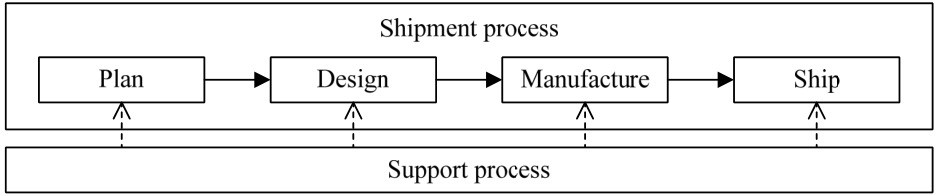
There are various types of projects including system development projects for developing a system, new product development projects for planning and producing a new product, and new business projects for planning and developing a new business. In all projects, in order to obtain the final deliverable (i.e., product), a shipment process for creating the product and a support process for supporting the creation of the product are implemented in addition to the project management process.
p. 311 · PDF 315
(1) Project influence elements
The following elements influence the execution of a project. The project constraints are decided on the basis of these influence elements.
- • Project environment This is the internal environment factors and external environment factors encompassing the project that may impact the success of the project. The project environment corresponds to such factors as the organization culture or system, national standards or industry standards, human resources or personnel management, and market situation or political situation.
- • Stakeholder This is an organization or individual having interests in the activities of the project. The stakeholder corresponds to the organization/enterprise, employees, shareholders, creditors, customers, suppliers (or vendors), local community, and governmental · 1 question
agencies that form the main constituents of a project.
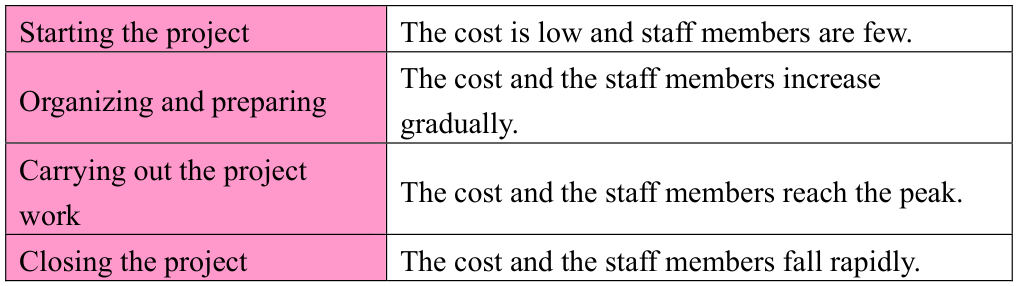
- • Project life cycle This is the life cycle from the initiation of a project until its end, which includes the predictive type, iterative type, incremental type, and adaptive type. [Characteristics of a general project life cycle]
| Starting the project | The cost is low and staff members are few. |
|---|---|
| Organizing and preparing | The cost and the staff members increase gradually. |
| Carrying out the project work | The cost and the staff members reach the peak. |
| Closing the project | The cost and the staff members fall rapidly. |
- • Project governance This is the governance (i.e., rule) of a project that is consistent with the governance of
the organization. It is implemented through the project life cycle.
p. 312 · PDF 316
(2) Project team
The project team (i.e., team executing the project) consists of a project manager and project members.
- • Project manager This is the leader who leads a project to its success. A project manager is required to have competency (i.e., behavioral characteristics) in terms of knowledge, practical ability (i.e., execution capability), and human qualities (i.e., leadership, communication, negotiation, conflict management, motivation).
- • Project members This is the staff members engaged in a project. In the organizational structure of a project, the project members are required to have the self-management capabilities to appropriately perform activity planning, progress management, quality management, cost management, risk management, change management, problem discovery/problem reporting, measures planning, documentation, and communication.
(3) Organizational structure of project
The organizational structure of a project refers to the project organization system and the project management support system as shown below.
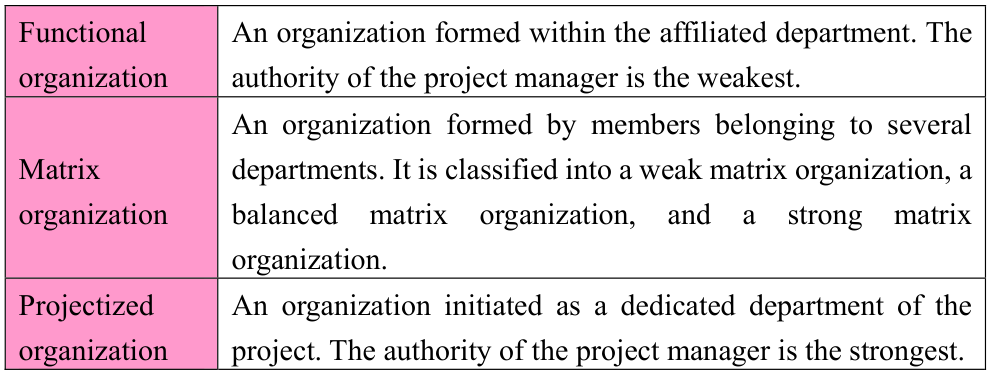
- • PBO (Project-Based Organization) This is the project organization system. PBO is one of the management organizations and is classified into the following three types:
| Functional organization | An organization formed within the affiliated department. The authority of the project manager is the weakest. |
|---|---|
| Matrix organization | An organization formed by members belonging to several departments. It is classified into a weak matrix organization, a balanced matrix organization, and a strong matrix organization. |
| Projectized organization | An organization initiated as a dedicated department of the project. The authority of the project manager is the strongest. |
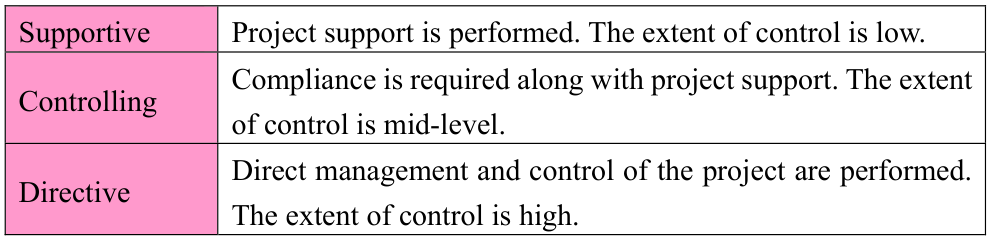
- • PMO (Project Management Office) This is a department or group that supports (or performs direct management of) project management by performing consolidated management or coordination of several projects. It may be thought of as a PMO (Program Management Office) specialized as
p. 313 · PDF 317
a project.
| Supportive | Project support is performed. The extent of control is low. |
|---|---|
| Controlling | Compliance is required along with project support. The extent of control is mid-level. |
| Directive | Direct management and control of the project are performed. The extent of control is high. |
1 - 2 Project Management Implementation Method
In many cases, the following guidelines (i.e., international standards) are used as the standard for implementing project management. When these guidelines are applied, tailoring (i.e., corrections/adjustments) must be performed in response to the characteristics of the project.
- • PMBOK (Project Management Body of Knowledge) This is a guide to the body of knowledge concerning project management that is issued by PMI (Project Management Institute).
- • ISO 21500 This is a comprehensive guideline on project management that is published by the ISO (International Organization for Standardization).
(1) Process groups
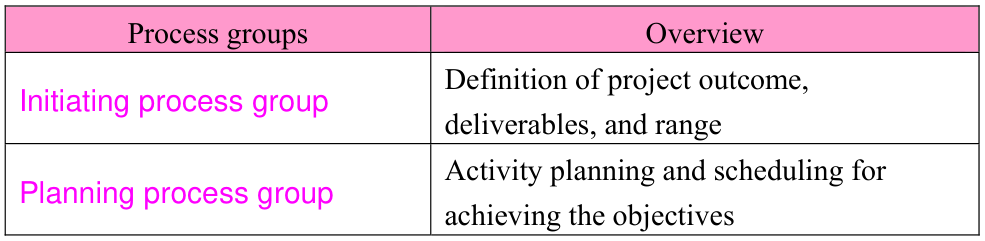
In PMBOK and ISO 21500, the project management processes (hereinafter, processes) that must be implemented in project management are classified into five process groups according to the flow of the project life cycle.
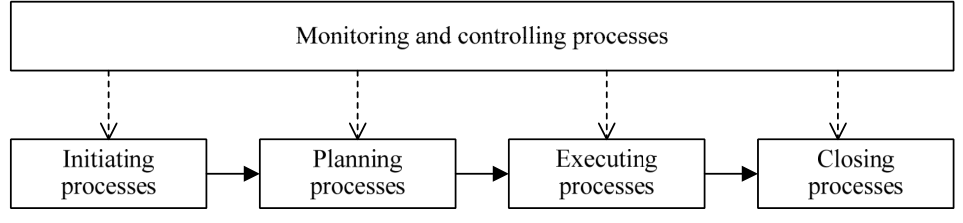
| Process groups | Overview |
|---|---|
| Initiating process group | Definition of project outcome, deliverables, and range |
| Planning process group | Activity planning and scheduling for achieving the objectives |
p. 314 · PDF 318
| Implementing process group [Executing process group] | Implementation [or execution] of the projects or the processes |
|---|---|
| Controlling process group [Monitoring and controlling process group] | Progress management and monitoring, and evaluation/improvement |
| Closing process group | Arrangement of deliverables and closing of the project or contract |
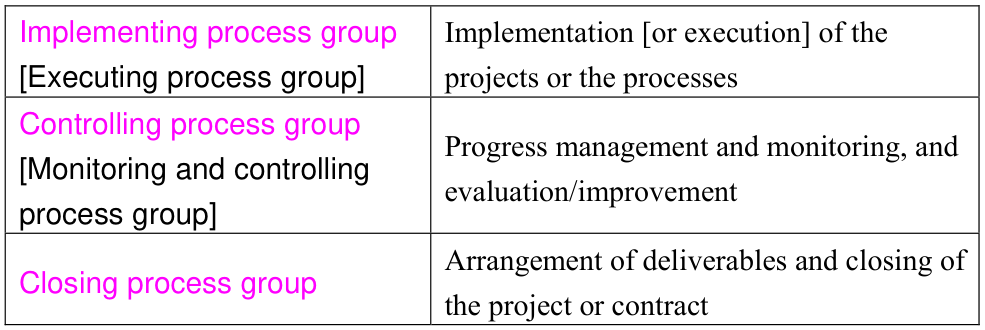
Note: The terms enclosed in brackets [ ] are used only in PMBOK.
(2) Subject groups (knowledge areas)
According to PMBOK and ISO 21500, a process is classified into the following 10 subject groups [knowledge areas] according to the applicable resources.
| Subject group (Knowledge area) | Main objects to be managed |
|---|---|
| Project integration subject [Project integration management] | Overall project activities |
| Project scope subject [Project scope management] | Scope (e.g., deliverables) |
| Project time subject [Project time management] | Schedule |
| Project cost subject [Project cost management] | Budget/cost |
| Project quality subject [Project quality management] | Quality policies and quality objectives |
| Project risk subject [Project risk management] | Project risks |
| Project stakeholder subject [Project stakeholder management] | Interested parties |
| Project resource subject [Project human resource management] | Human resources/physical resources Note: PMBOK describes human resource only. |
| Project procurement subject [Project procurement management] | Procurement of external resources |
| Project communications subject [Project communications management] | Project information |
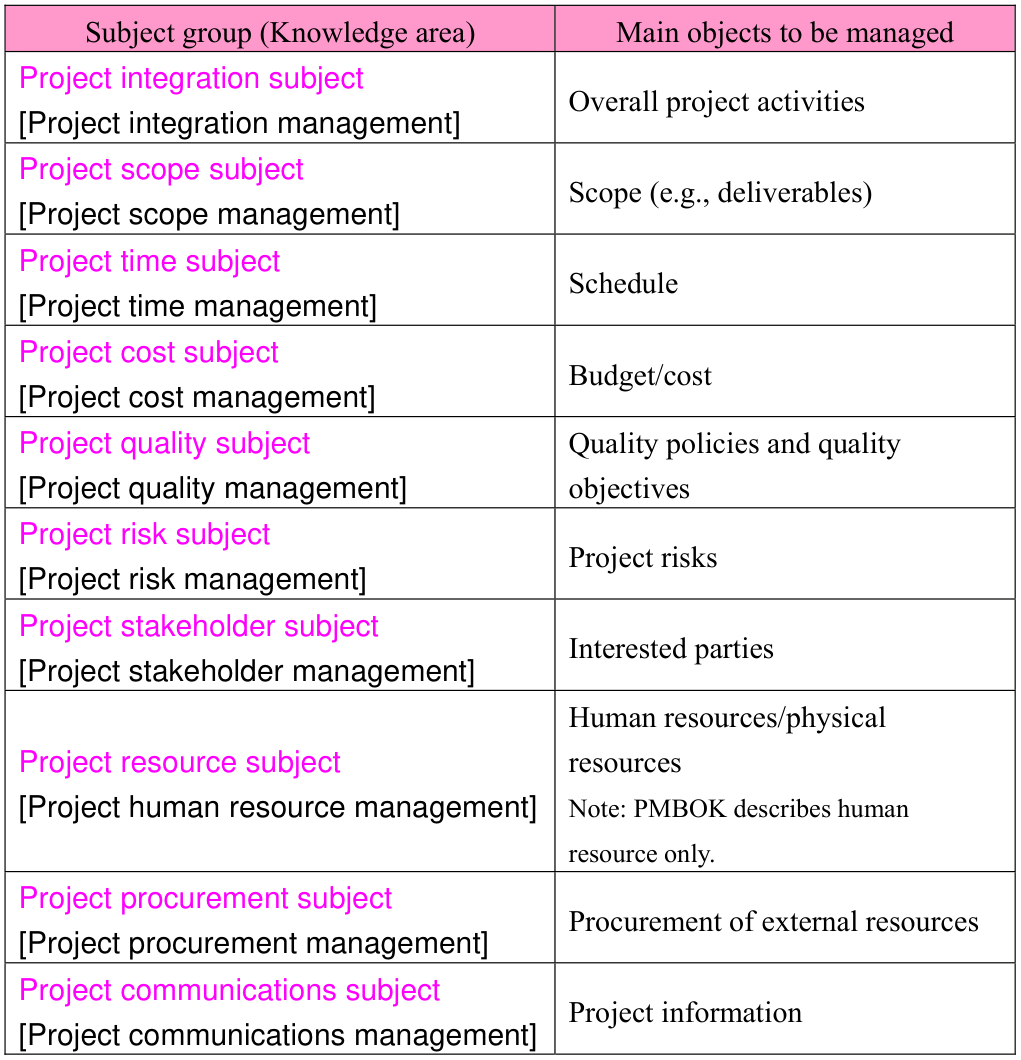
Note: The terms enclosed in brackets [ ] are used only in PMBOK.
p. 315 · PDF 319
In PMBOK and ISO 21500, processes are compiled together on the basis of a table (i.e., process map) configured by process groups and subject groups. (For example, in the initiating process, the “project charter development” process is implemented for the project integration subject.)
In this textbook, the typical processes are explained in order from the viewpoint of management implemented in each subject group on the basis of PMBOK and ISO 21500.
p. 316 · PDF 320
2 Subject Group Management
This section describes the purposes and typical processes of the subject groups (knowledge areas) related to quality, cost, and delivery, which are the project constraints, while focusing on the subject group management.
2 - 1 Project Integration Management
The purpose of project integration management is to identify, define, combine, unify, and coordinate the processes and the project management activities of each subject group. In order to define, control, and manage the overall project management activities, the following processes are implemented.
| Process groups | Process to implement |
|---|---|
| Initiating | Develop project charter |
| Planning | Develop project plans [Develop project management plan] |
| Implementing [Executing] | Direct project work [Direct and manage project work] |
| Controlling [Monitoring and controlling] | Control project work [Monitor and control project work] |
| Control changes [Perform integrated change control] | |
| Closing | Close project phase or project [Close project or phase] Collect lessons learned |
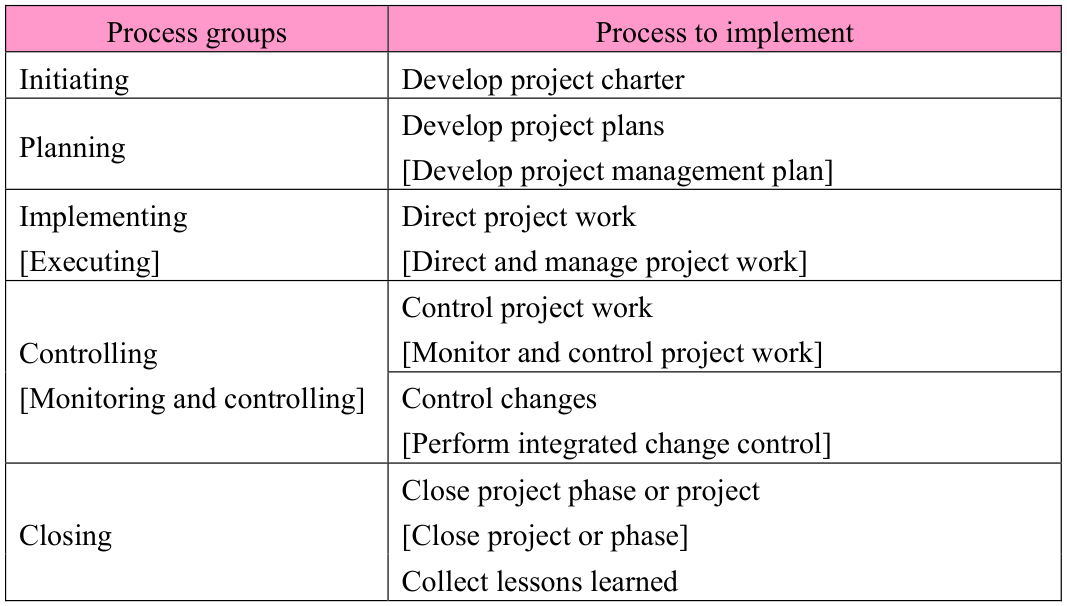
Note: The terms enclosed in brackets [ ] are used only in PMBOK.
(1) Development of a project charter
In this process, a project charter is developed on the basis of the project statement of work that describes the products expected from the project and the environmental factors or process assets of the organization body. The project charter is a document that declares the initiation of a project that is formally approved by the organization.
[Descriptions included in the project charter]
p. 317 · PDF 321
stakeholders, pre-requisites and constraints concerning the organization and related institutions, the overview and scope of the project, risks of the project, an overview of the overall schedule (i.e., summary milestone schedule), approximation of the overall budget (i.e., summary budget), responsibilities and authorities of the appointed project managers, a list of stakeholders, the approver and proponent (initiator) of the project charter, and so on.
In order to create the project charter, techniques such as feasibility study are used, in which investigation and verification are conducted to determine the execution possibility concerning the decision and facilitation of experts, and planning of a new business or a new project.
(2) Development of project management plan
From the project charter, subsidiary plans (i.e., basic rules such as planning, methods, and effective measurement methods) for management are developed, other than project integration management. The auxiliary plans are aggregated with the performance measurement baseline (i.e., scope baseline, schedule baseline, cost baseline) that are defined in the processes of other subject groups, and integrated into the project management plan.
[Descriptions included in the project management plan] Project life cycle and applicable processes, tailoring items (e.g., clarification of processes, execution level of each process, techniques and tools to use), method of implementing change control (e.g., change management plan), method of communicating with stakeholders, method/content and scope/implementation period of problem resolution, and method of implementing activities for achievement of the objectives, and so on
(3) Integrated change control
This process performs centralized control of the change requests (corrective actions, preventive actions, and defect corrections) concerning the project and maintains the integrity of the project. The feasibility of a change request is decided on the basis of the decision of an expert or the reviews conducted in meetings, and it is approved by the project manager or CCB (Change Control Board). The approved change request is soon implemented, and the entire series of actions concerning the change request are described in a change directory. It must be noted that the project management plan and related project documents are also updated according to the change content.
p. 318 · PDF 322
(4) Closing of a project or a project phase
In order to close a project or a project phase (i.e., the project category controlled for acquiring important deliverables), all processes described in the project management plan is closed, and then the project or the project phase is formally completed. The project that is completed because the objective of the project is accomplished, performs a transfer (e.g., a delivery) of the final deliverable (product) and project asset management (e.g., update of process assets). On the other hand, for a project that is closed (or aborted) because the objective of the project could not be accomplished, a material is developed in which the cause or reason of failure and the background details are described. In both cases, as the formal documents indicating the completion of the project, a project completion report and a closing report for the project or the project phase are developed. Also, the lessons learned through the implemented project is compiled as a “Lessons learned document” for use in future projects and project phases, and is registered in the learning knowledge base.
2 - 2 Project Scope Management
| Process groups | Process to implement |
|---|---|
| Initiating | – |
| Planning | Define activities [Plan scope management, Collect requirements] |
| Define scope | |
| Create WBS (Work Breakdown Structure) | |
| Implementing [Executing] | – |
| Controlling [Monitoring and controlling] | Control scope [Validate scope, Control scope] |
| Closing | – |
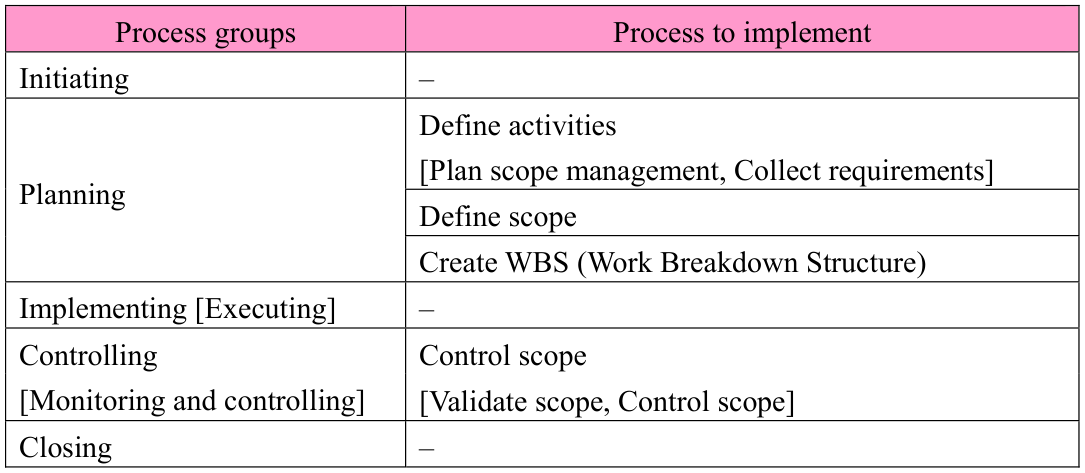
Note: The terms enclosed in brackets [ ] are used only in PMBOK.
p. 319 · PDF 323
(1) Development of scope management plan
(2) Definition of a scope
This process clearly identifies the deliverables and the activities necessary for achieving the deliverables as the deliverable scope and the project scope. In order to achieve this, first of all, the requirements of the stakeholders are collected according to the requirements management plan, and then the collected requirements are documented as a requirements document. (There is also a concept to make this activity independent as a requirements collection process.) By using the scope definition methods specified in the requirements document and the scope management plan, the project scope is defined and a project scope statement is developed.
[Descriptions included in the project scope statement] Deliverable scope description, project deliverables and acceptance criteria, items excluded from the project, and project pre-requisites and constraints.
(3) Creation of WBS (Work Breakdown Structure)
p. 320 · PDF 324
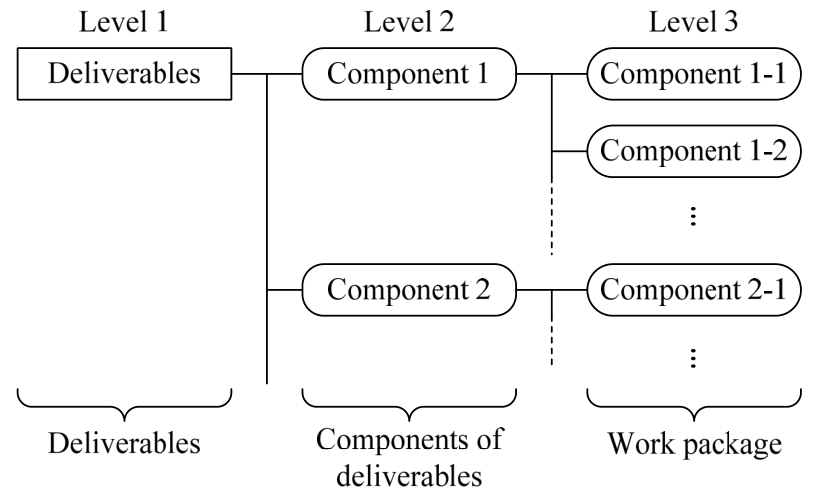
The result of WBS creation is documented as the scope baseline. The scope defined as the baseline is used as the monitoring and controlling decision criteria in the project life cycle.
[Components of scope baseline]
- • Project scope statement (output of scope definition)
- • WBS
- • WBS dictionary: A supplementary document describing the details of WBS components (e.g., the
work package)
(4) Scope control
Section progress
Original chapter exercises
Original chapter exercises →New FE Textbook Vol.2 · First Edition, April 2015