Highlighted text? Practice this concept. Highlighted passages and figures open related questions.
Practice related questions (1)Progress & bookmarks
Current section
2-5 Project Quality Management
p. 328
Progress
Not marked complete
Related questions in this lesson 1
Project quality assurance1p. 328 · PDF 332
2 - 5 Project Quality Management
The purpose of project quality management is to clarify of the quality of the project and products, and to control the project in order to satisfy the quality. Use CMMI (Capability Maturity Model-Integrated) as the quality standard of the project and the software quality characteristics of ISO/IEC 9126 (JIS X 0129) as the quality standard of the products. In order to achieve the purpose of the project and the quality desired by the stakeholders, the following processes are implemented in conformity to the ISO 9000 (JIS Q 9000) series (i.e., standard concerning the quality management system).
| Process groups | Process to implement |
|---|---|
| Initiating | – |
| Planning | Plan quality [Plan quality management] |
| Implementing [Executing] | Perform quality assurance |
| Controlling [Monitoring and controlling] | Perform quality control [Control quality] |
| Closing | – |
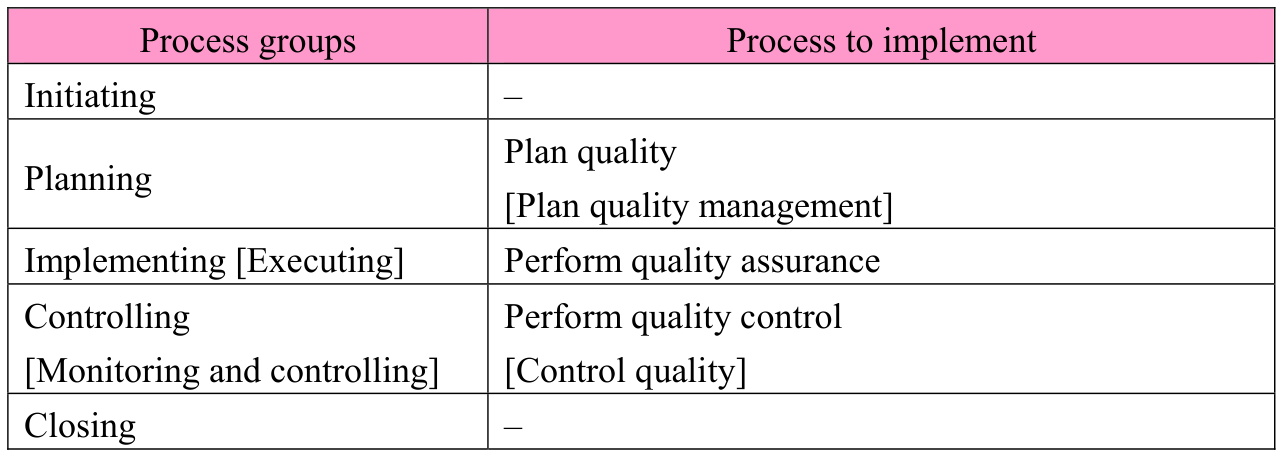
Note: The terms enclosed in brackets [ ] are used only in PMBOK.
(1) Quality management plan
On the basis of the project management plan, the subsidiary plans, and the requirements document, the quality requirements or quality standards concerning the project and the products are specified. Then, a quality management plan is developed which describes the quality policies, quality objectives, and quality plan for securing the quality level. The quality management plan also includes activities towards continuous process improvements. The following techniques and tools are used in quality management planning.
- • QFD (Quality Function Deployment)
This is a technique used to clarify the requirements concerning the products and services, and deploy them in specifications needed to develop the products and services meeting those requirements. - • COQ (Cost of Quality)
This is the total cost of quality. The cost of quality is on the basis of the concept called “Prevention over Inspection” according to which “The cost of preventive action for a
defect is much less as compared with the cost of corrective actions.” Moreover, in the case of the waterfall model, the cost of correcting a defect that occurs at an early stage (e.g., design process) is more than the cost of correcting a defect that occurs at a later
p. 329 · PDF 334
stage (e.g., the programming process).
- • Seven QC Tools
These are the quality control techniques and include Pareto chart, histogram, scatter diagram, control chart, stratification, check sheet, and cause-and-effect diagram. (Refer to p.77 for details.) - • Benchmark (benchmarking)
This is a technique of identifying the best practice of a project that is being executed (or under planning), or examining an improvement plan by comparing it with a similar plan.
(2) Quality assurance
- • New Seven QC Tools
These are the quality control techniques and include affinity diagram, association diagram, matrix diagram, matrix data analysis, arrow diagram, tree diagram (logic tree), and PDPC (Process Decision Program Chart). (Refer to p.77 for details.) - • Quality audit
In this technique, a third party investigates and evaluates systematically whether the project conforms to the quality policies, the processes, and the procedures. During quality audit, the implementation status of already-approved change requests is checked, which includes corrective actions, preventive actions, and defect correction. - • Process analysis
The process analysis examines the problems and contradictions, and worthless activities that occur during the execution of processes, and identifies the improvement plans necessary in the process.
p. 330 · PDF 335
(3) Quality control
This process monitors, according to the quality management plan, if the quality requirements and quality standards that are defined during quality management planning are achieved. In addition, the monitoring results are recorded, and if there is a quality defect in a process or a product, the action plans are made and implemented in order to identify and remove the cause. In quality control, the same techniques and tools as during quality management planning and quality assurance are used. Also, the inspection is performed to see if the result of activities conforms to the quality standards. The inspection is performed onto the activity results and final deliverable (e.g., product) of each activity unit. The results of inspection and the records of detected failures are documented as a failure report, and the failures are dealt by either corrective actions or defect correction. At this time, the result of the corrective action or defect correction is confirmed by an inspection. In a software (or system) development project, a review (e.g., walk-through, inspection) and a test (e.g., a unit test, join test, qualification test) are included in the inspection. The review execution time and the number of tested items (or coverage rate), which are included in the results, are part of the quality management indexes or indicators of software. Also, it must not be forgotten that during quality management, not only the system and software, but also various documents need to be managed.
Section progress
Original chapter exercises
Original chapter exercises →New FE Textbook Vol.2 · First Edition, April 2015