Highlighted text? Practice this concept. Highlighted passages and figures open related questions.
Practice related questions (1)Progress & bookmarks
Current section
2-7 Management of Other Subject Groups
p. 333
Progress
Not marked complete
Related questions in this lesson 1
Push communication1p. 333 · PDF 339
2 - 7 Management of Other Subject Groups
2-7-1 Project Stakeholder Management
The purpose of project stakeholder management is to clearly identify the stakeholders (i.e., interested parties: individuals, groups, and organizations affected by, or affecting the project) and to perform control so as to build and maintain a favorable relationship with the stakeholders. The following processes are implemented in order to proceed smoothly with the project while a favorable relationship is built and maintained with the stakeholders.
| Process groups | Process to implement |
|---|---|
| Initiating | Identify stakeholders |
| Planning | [Plan stakeholder management] |
| Implementing [Executing] | Manage stakeholders [Manage stakeholder engagement] |
| Controlling [Monitoring and controlling] | [Control stakeholder engagement] |
| Closing | – |
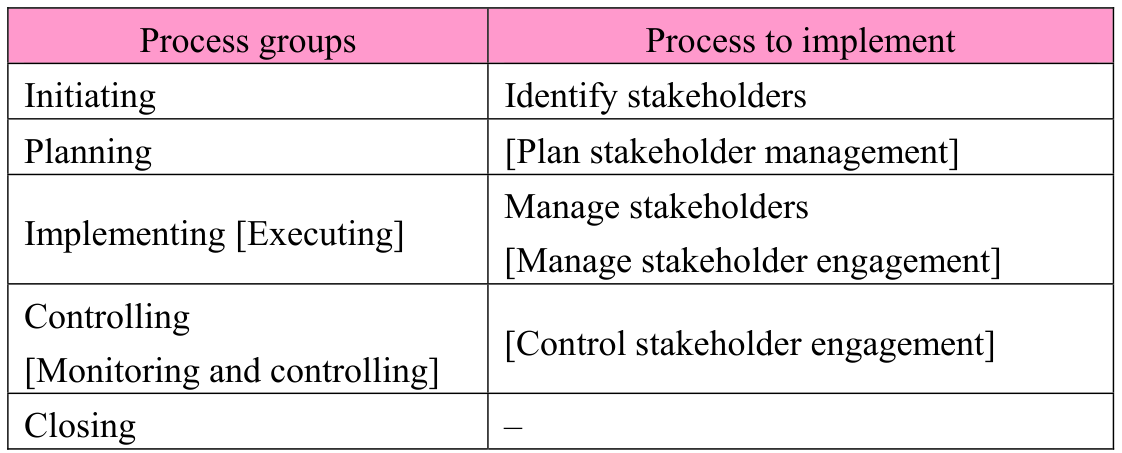
Note: The terms enclosed in brackets [ ] are used only in PMBOK.
(1) Identification of stakeholders
This process identifies the stakeholders and the impact that the stakeholders bring about on the basis of the project charter, and creates a stakeholder register. The identified stakeholders are classified on the basis of the authority and the interest level, the authority and the participation level, the participation level and influence, and the salience model (which classifies stakeholders by using three factors: power, urgency, and legitimacy).
(2) Stakeholder management plan
A plan is drafted for encouraging the identified stakeholders to effectively participate in the project, and a stakeholder management plan is developed. At this time, a stakeholder engagement (active participation in the project) is analyzed, which forms an important element for leading the project to its success, on the basis of five stages namely Unaware, Resistant, Neutral, Supportive, and Leading.
p. 334 · PDF 340
(3) Stakeholder engagement management
A favorable relationship with the stakeholders is built and maintained under the responsibility of the project manager according to the stakeholder management plan. At this time, the content of the information transmitted to the stakeholders and the transmission means conform to the communications management plan that is created in project communication management. By improving stakeholder engagement, it is expected that the project will be supported and the risks caused by the stakeholders will be reduced.
2-7-2 Project Resource Management
The purpose of project resource management is to clarify of the resources necessary for achieving the purpose of the project, and to control the resources. In addition to human resources such as staff members like the project manager and the project members, the project management team (team that performs management activities within the project), and organization systems such as PBO (Project-Based Organization) and PMO (Project Management Office), resources include physical resources such as devices, equipment, material, software, and hardware. In project resource management, these resources are estimated and arranged appropriately without any excess or deficiency. In PMBOK, the following processes are implemented as project human resources management in order to perform control concerning human resources.
| Process groups | Process to implement |
|---|---|
| Initiating | Establish project team |
| Planning | Estimate resources Define project organization [Plan human resource management] |
| Implementing [Executing] | [Acquire project team] |
| Develop project team | |
| [Manage project team] | |
| Controlling [Monitoring and controlling] | Control resources Manage project team |
| Closing | – |
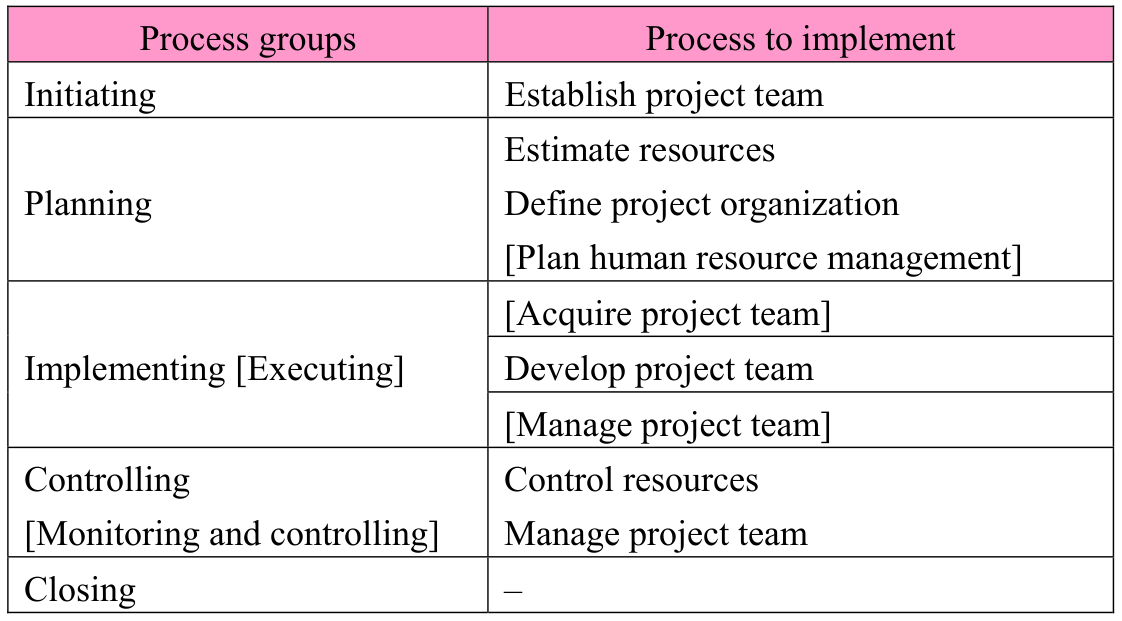
Note: The terms enclosed in brackets [ ] are used only in PMBOK.
p. 335 · PDF 341
(1) Human resource management plan
This process creates a human resource management plan (i.e., a subsidiary plan) that is composed of “roles and responsibilities,” “project organization chart,” and “staff members management plan” on the basis of the content that is described in the project management plan.
(2) Establishment of a project team / development of a project team
The members who are necessary for completing the project are collected according to the human resource management plan, and a project team is started. In order to enable the project team to exhibit sufficient performance, the ability of the project team is developed and enhanced.
[Project team organization]
- • Chief programmer team
Staff members such as programmers, backup programmers, and a librarian are assigned under the chief programmer, and the development work progresses under the guidance of the chief programmer. - • Specialist team
Several technical specialists from specialized fields assist one chief programmer who creates all programs.
2-7-3 Project Procurement Management
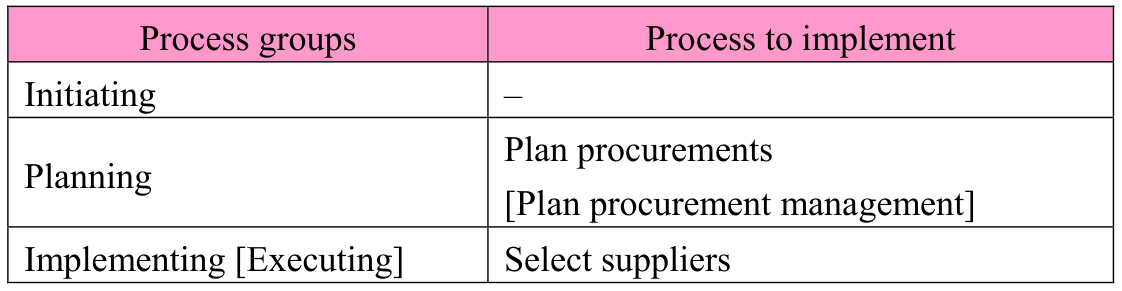
The purpose of project procurement management is to acquire or purchase the resources necessary from outside of the project team for executing the project. In addition to outsourcing and system integrator, the methods of utilization of external resources include co-sourcing, which is a form of outsourcing in which the outsourcee and the outsourcer perform their work at equal positions and distribute the profits, and IDC (Internet Data Center), which is a data center specializing in Internet connections. The following processes are implemented in project procurement management. As for the actual procurement procedures, the acquisition processes of Common Framework 2013 are commonly applied. (Refer to p.222 for details on the procurement procedures.)
| Process groups | Process to implement |
|---|---|
| Initiating | – |
| Planning | Plan procurements [Plan procurement management] |
| Implementing [Executing] | Select suppliers |
p. 336 · PDF 342
| [Conduct procurements] | |
| Controlling [Monitoring and controlling] | Administer procurements [Control procurements] |
|---|---|
| Closing | [Close procurements] |
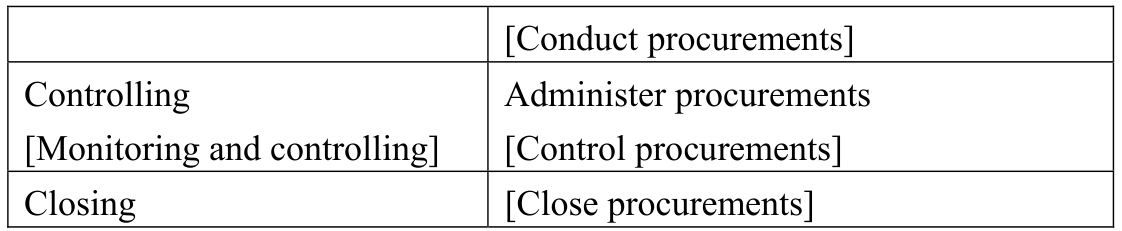
Note: The terms enclosed in brackets [ ] are used only in PMBOK.
(1) Procurement management plan
This process specifies the procurement standard (i.e., supplier selection criteria) and procurement contract type, and create a procurement management plan. Also, it is necessary to prepare various procurement documents: the procurement statement of work that defines the scope of activities for procurement; RFI (Request For Information), RFP (Request For Proposal), and RFQ (Request For Quotation) that are used during procurement; and such other documents.
[Procurement contract type]
- • Fixed price contract (lump-sum contract)
The supplier provides products and services at a fixed remuneration up to the specified deadline. Since the amount is fixed, there is less risk to the acquirer. - • Cost-reimbursable contract
The supplier adds a profit to the cost and charges the acquirer. Since the total cost is not clear at the time of the contract, the risk to the acquirer is high.- • Cost plus fixed fee contract
In this type of contract, a fixed profit (i.e., fixed fee) is added to the cost. - • Cost plus incentive fee contract
In this type of contract, an incentive that is in response to the objectives accomplishment level is added to the cost.
- • Cost plus fixed fee contract
- • T&M contract (Time and material contract)
The supplier charges the acquirer an amount obtained by multiplying the actual work time and the amount of resources used with the unit value set for the time and the material. Since the total cost is not clear at the time of the contract, the risk to the acquirer is high.
2-7-4 Project Communications Management
The purpose of project communications management is to control the communication with the stakeholders and the communication within the project team by appropriately performing the tasks from generation of information up to its disposal in the project.
p. 337 · PDF 343
The following processes are implemented in project communications management.
| Process groups | Process to implement |
|---|---|
| Initiating | – |
| Planning | Plan communications [Plan communications management] |
| Implementing [Executing] | Distribute information [Manage communications] |
| Controlling [Monitoring and controlling] | Manage communications [Control communications] |
| Closing | – |
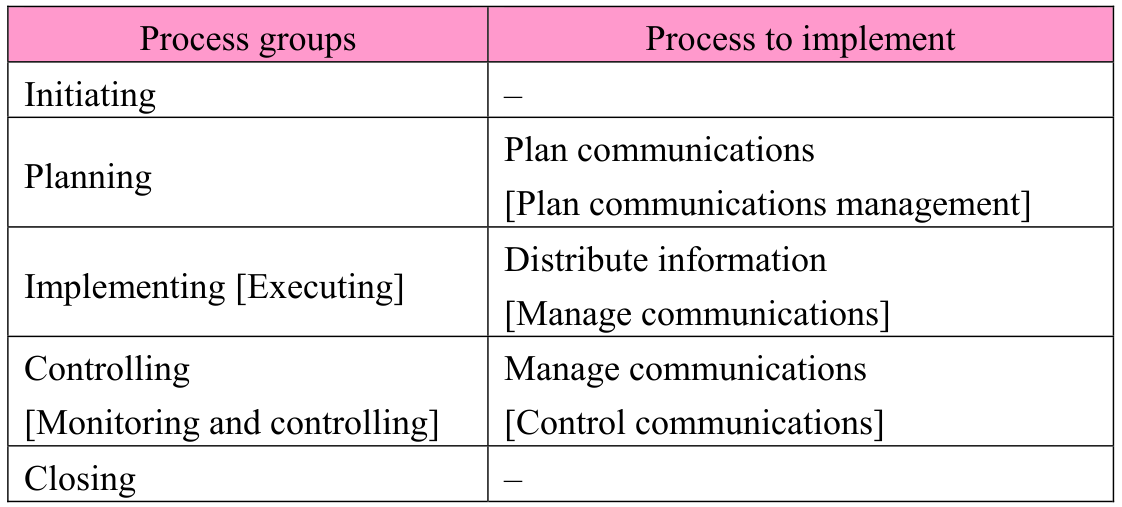
Note: The terms enclosed in brackets [ ] are used only in PMBOK.
(1) Communications management plan
This is the process of creating a communications management plan and setting the stakeholders’ requirements, along with the information/language/format/content/detailing to be conveyed, and the communication methods.
[Communication methods]
- • Interactive communication (bidirectional communication)
This is a method in which information is exchanged mutually between two or more parties, such as meetings, conversations, and video conferences. Since this results in a feedback loop in which opinions are mutually exchanged, it is also called feedback communication. - • Push communication
This is a method of distributing information to specific recipients who need to receive the information. Push communications include letters, e-mails, voice mails, reports, faxes, and such others. · 1 question - • Pull communication
This is a method of obtaining information at recipients’ discretion from websites on the Internet or the Intranet and from printed materials such as newspapers and magazines. It is used when there are many unspecified recipients or a large amount of information.
(2) Communications management
Generation, collection, distribution, storage, and search of information is performed effectively in a project according to the communications management plan. In particular, when information
p. 338 · PDF 344
such as project performance and deliverables is distributed to stakeholders, it is necessary to make efforts to convert the scope, schedule, cost, and quality into an easy-to-understand format. The feedback of the stakeholders concerning information distribution is utilized in performance correction and process improvement of the project.
Section progress
Original chapter exercises
Original chapter exercises →New FE Textbook Vol.2 · First Edition, April 2015