Practice related questions (8)Progress & bookmarks
Current section
2 Basic Algorithm
p. 416
Practice this section 8 linked exam questions with default filters
Progress
Not marked complete
p. 416 · PDF 426
2 Basic Algorithm
An algorithm is a sequence of solving a problem or a sequence that is used when a process is performed on a computer. An algorithm should have as much processing efficiency as possible, and it should be easy to understand. This section explains how to write flowcharts that describe algorithms, and also explains typical algorithms.
2 - 1 Flowchart
Flowchart is a commonly used notational convention of algorithms. Its main advantage is that it is visually easy to understand because the processing sequence is represented as a combination of symbols.
2-1-1 Main Symbols
The following are the main symbols that are used in flowcharts.
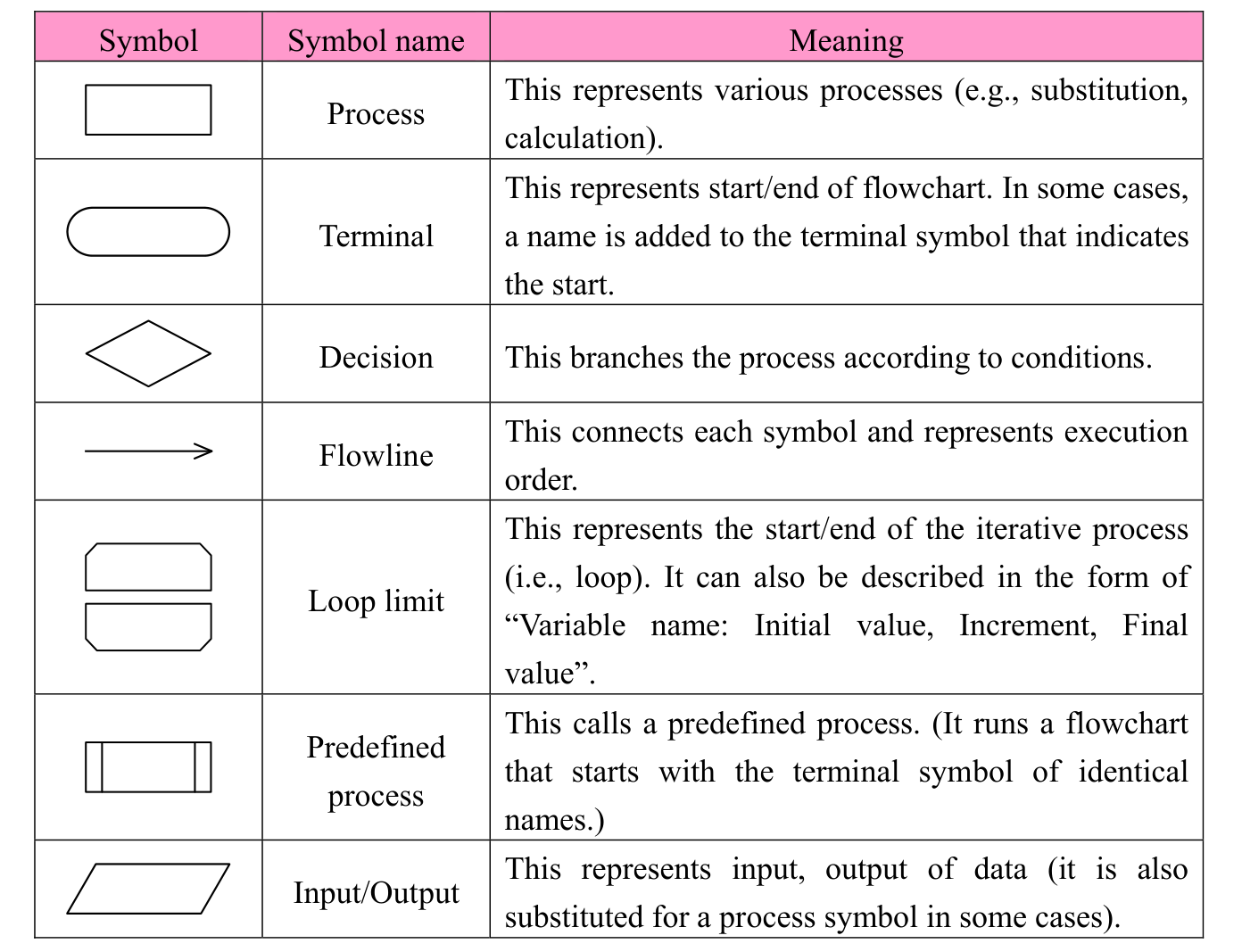
Original source text
Symbol
Symbol name
Meaning
This represents various processes (e.g., substitution,
Process
calculation).
This represents start/end of flowchart. In some cases,
Terminal
a name is added to the terminal symbol that indicates
the start.
Decision
This branches the process according to conditions.
This connects each symbol and represents execution
Flowline
order.
This represents the start/end of the iterative process
(i.e., loop). It can also be described in the form of
Loop limit
“Variable name: Initial value, Increment, Final
value”.
This calls a predefined process. (It runs a flowchart
Predefined
that starts with the terminal symbol of identical
process
names.)
This represents input, output of data (it is also
Input/Output
substituted for a process symbol in some cases).
Source visual description
Original Basic Algorithm source layout. Source labels: Symbol; Symbol name; Meaning; Process; This represents various processes (e.g., substitution,.
p. 417 · PDF 427
[Structured chart]
Structured charts that are used for representing algorithms include PAD, NS chart, and so on.
Section progress
Original chapter exercises
Original chapter exercises →New FE Textbook Vol.1 · IT Fundamentals · First Edition, April 2015