Highlighted text? Practice this concept. Highlighted passages and figures open related questions.
Practice related questions (2)Progress & bookmarks
Current section
2-5 Algorithm Design
p. 443
Practice this section 2 linked exam questions with default filters
Progress
Not marked complete
Related questions in this lesson 3
Recursive calls and terminating cases2Decision-table conditions and actions1p. 443 · PDF 453
2 - 5 Algorithm Design
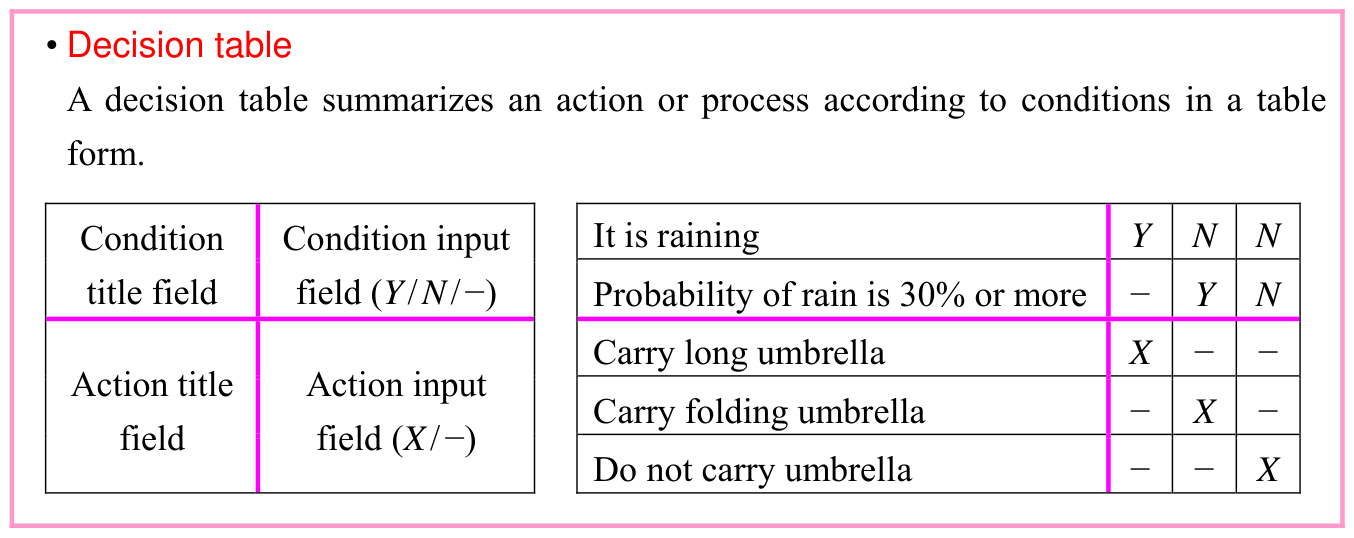
Algorithm design refers to conducting problem analysis and creating an algorithm. In problem analysis, type and data structure of input data/output data, relation between data items are defined, and complex process conditions are summarized in a decision table, or other method.
Original source text
• Decision table
A decision table summarizes an action or process according to conditions in a table
form.
Condition
Condition input
It is raining
Y
N
N
title field
field (Y/N/−)
Probability of rain is 30% or more
−
Y
N
Carry long umbrella
X
−
−
Action title
Action input
Carry folding umbrella
−
X
−
field
field (X/−)
Do not carry umbrella
−
−
X
Source visual description
Original Algorithm Design source layout. Source labels: • Decision table; A decision table summarizes an action or process according to conditions in a table; form.; Condition; title field.
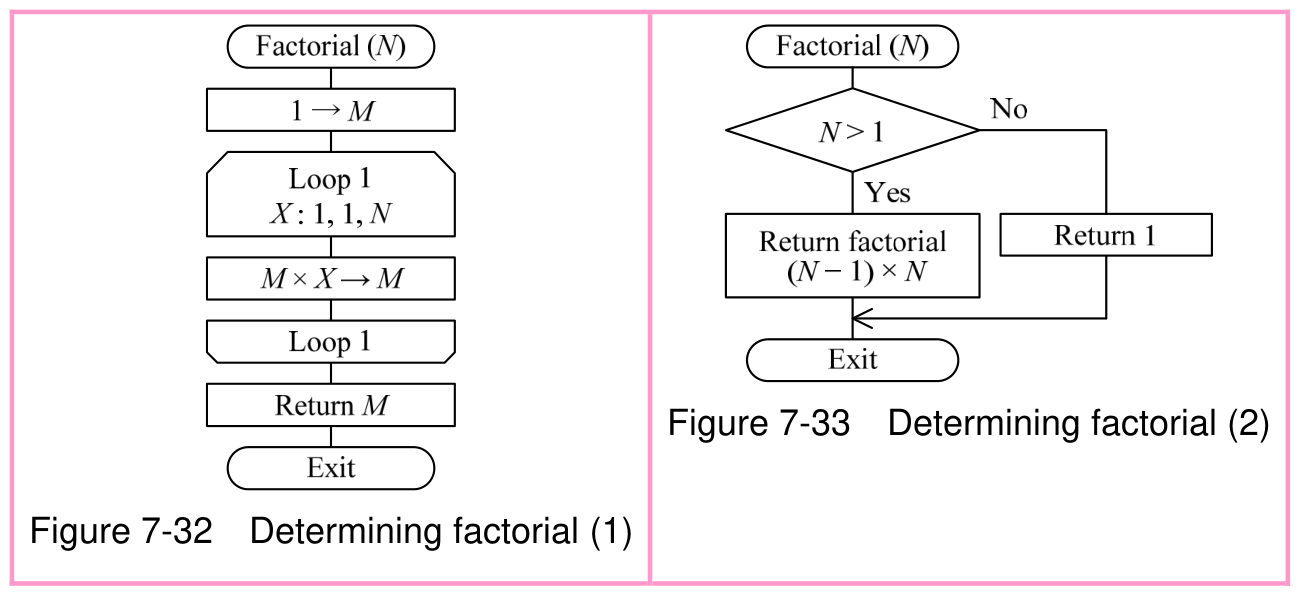
For creating an algorithm, when the problem is large and complex, the divide-and-conquer approach is also used that splits the problems into smaller problems, and then, each of the smaller problems is solved. When the divide-and-conquer approach is used, the algorithm
p. 444 · PDF 454
becomes recursive in most of the cases (e.g., quick sort). For example, when the algorithm in Figure 7-32, which determines factorial of 1 through N (N > 2), is prepared on the basis of the concept of the divide-and-conquer approach (with a focus on what to do with respect to N), it becomes recursive as shown in Figure 7-33.
Original source text
Figure 7-33  Determining factorial (2)
Figure 7-32  Determining factorial (1)
Source visual description
The original Factorial(N) drawings show loop-based multiplication and the recursive Factorial(N minus one) call side by side.
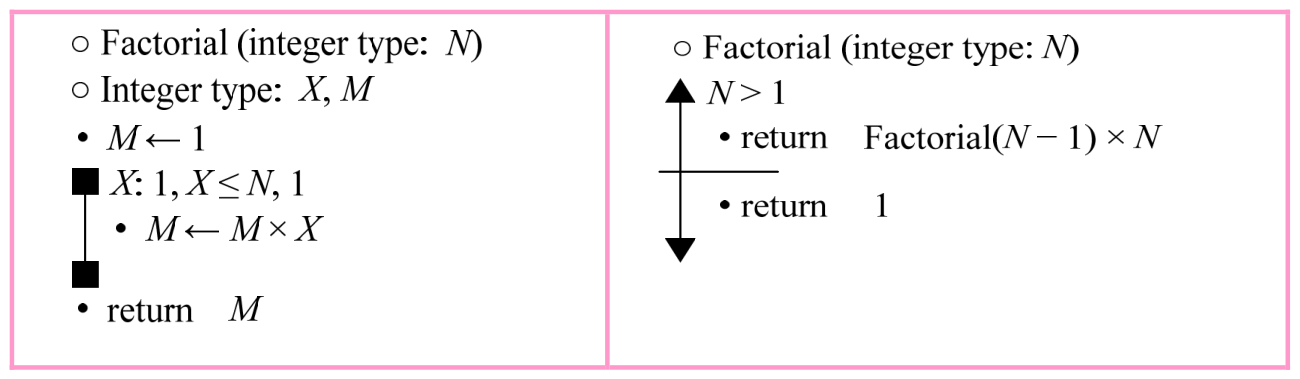
In addition, the algorithm in the figure above can also be represented by using pseudo-language.
Source visual description
Original Algorithm Design source layout. Source labels: .
Section progress
Original chapter exercises
Original chapter exercises →New FE Textbook Vol.1 · IT Fundamentals · First Edition, April 2015