Highlighted text? Practice this concept. Highlighted passages and figures open related questions.
Practice related questions (7)Progress & bookmarks
Current section
1 System Audit
p. 378
Practice this section 7 linked exam questions with default filters
Progress
Not marked complete
Related questions in this lesson 1
Audit classification1p. 378 · PDF 385
1 System Audit
A system audit is a way to objectively certify whether or not the measures against risks concerning the information system are developed and operated appropriately from an independent standpoint. In addition, accountability to the stakeholders is fulfilled by sharing the audit results.
1 - 1 Purpose and Concept of Audit
An audit refers to supervising/verifying an event or a subject. Apart from system audits, audits related to companies and information systems include the following.
View original source box · p. 378
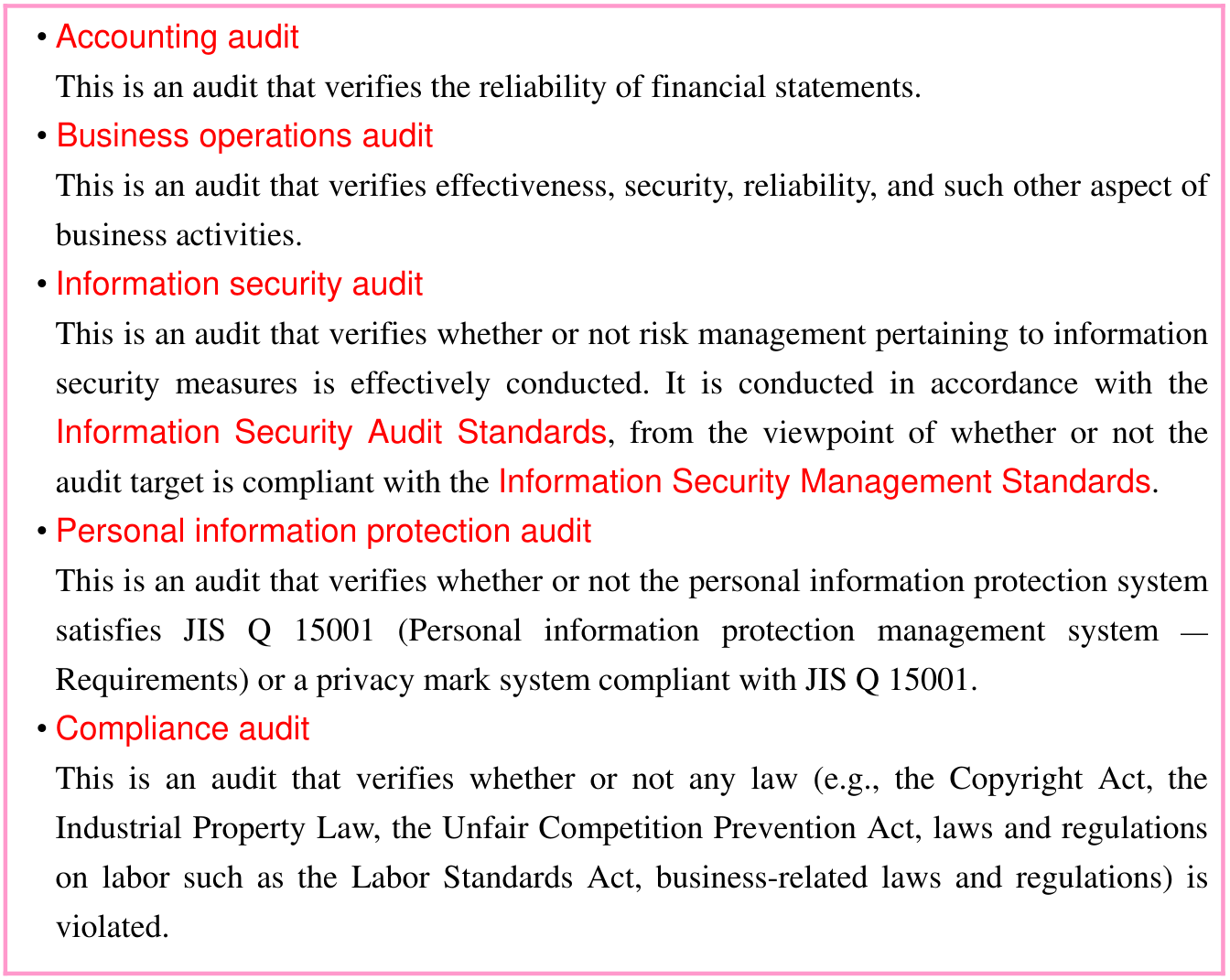
The bordered list identifies accounting, business operations, information security, personal information protection and compliance audits, followed by each original description.
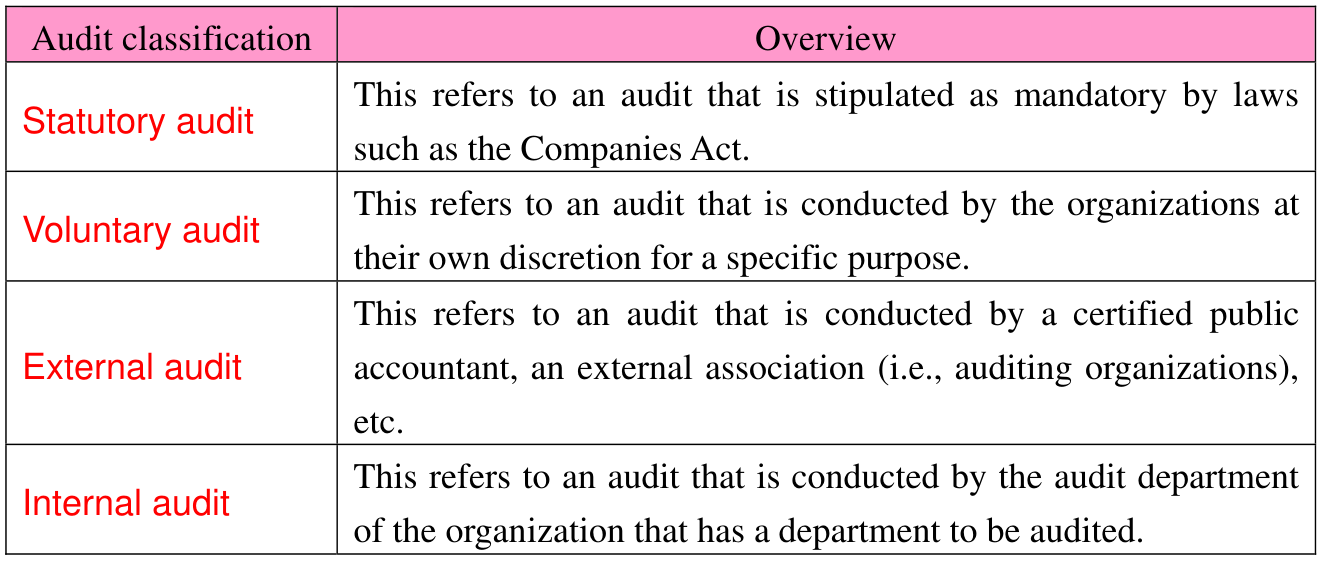
While audits have the following sections, these are not exclusive. For example, an accounting audit, which is one of the statutory audits, is conducted as an external audit by a certified public accountant.
p. 379 · PDF 386
| Audit classification | Overview |
|---|---|
| Statutory audit | This refers to an audit that is stipulated as mandatory by laws such as the Companies Act. |
| Voluntary audit | This refers to an audit that is conducted by the organizations at their own discretion for a specific purpose. |
| External audit | This refers to an audit that is conducted by a certified public accountant, an external association (i.e., auditing organizations), etc. |
| Internal audit | This refers to an audit that is conducted by the audit department of the organization that has a department to be audited. |
In addition, for the purpose of popularizing audits, the “list of companies providing system auditing services” and the “list of companies providing information security auditing services” are published, which are the summarized list of parties (including individual business operators) that conduct audits according to the audit standards and management standards defined by the Ministry of Economy, Trade and Industry. Users can access these lists.
Section progress
Original chapter exercises
Original chapter exercises →New FE Textbook Vol.2 · First Edition, April 2015