Highlighted text? Practice this concept. Highlighted passages and figures open related questions.
Practice related questions (4)Progress & bookmarks
Current section
(2) System audit implementation (preliminary audit, main audit, evaluation, and conclusion)
p. 382
Practice this section 4 linked exam questions with default filters
Progress
Not marked complete
Related questions in this lesson 7
System audit evidence and working papers6Computer assisted audit techniques1p. 382 · PDF 389
(2) System audit implementation (preliminary audit, main audit, evaluation, and conclusion)
System audit implementation is done in the sequence of preliminary audit, main audit, and evaluation and conclusion on the basis of individual plans. Here, the system auditor appropriately conducts the audit procedures, collects adequate audit evidence required for supporting the audit results in terms of given assurance or advice, and evaluates them. Audit evidence refers to the facts that are required for substantiating the audit opinion of the system auditor. Audit evidence is broadly classified into the following four types.
View original source box · p. 382
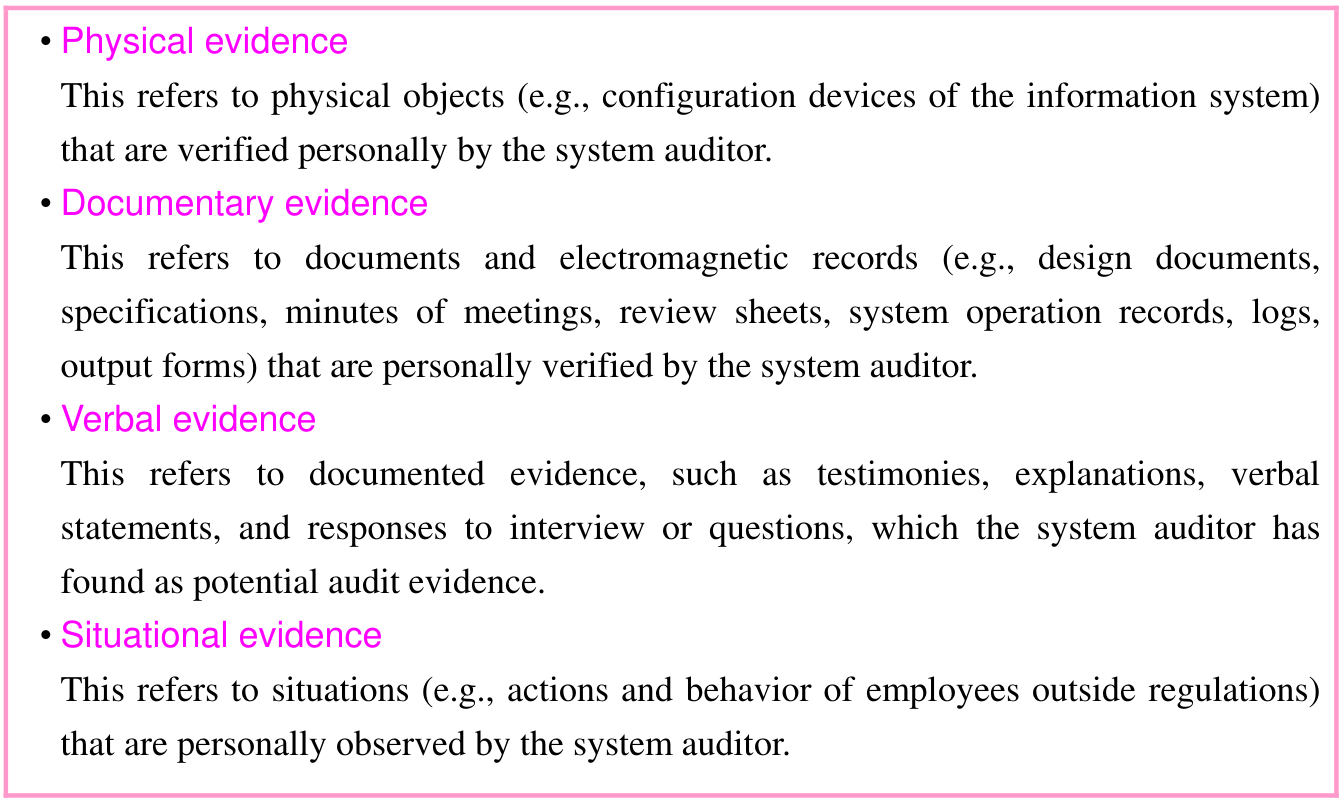
The original bordered list describes physical, documentary, verbal and situational audit evidence.
The system auditor uses an appropriate audit procedure for obtaining audit evidence. Audit procedures are procedures of selecting and operating appropriate system audit techniques for collecting adequate audit evidence required for rational evaluation and conclusion of the audit items.
View original source box · p. 382
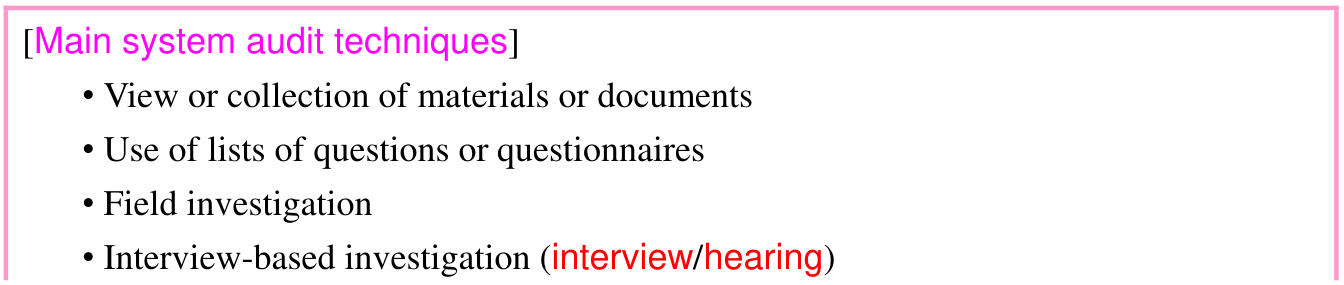
The box begins the main system audit techniques list: materials or documents, questions or questionnaires, field investigation, and interview-based investigation. Its last item continues on printed page 383.
p. 383 · PDF 390
View original source box · p. 383

The continued box completes the list with use of audit tools, on printed page 383. The original upper border remains open at this page continuation.
1) Preliminary audit
It is conducted for clearly understanding the actual state of the audit target. In a preliminary audit, the auditor collects and views questionnaires and material, and conducts interview-based investigation (i.e., interviews/hearings) with the concerned persons. In this way, the auditor understands things such as whether or not risks of the information system to be audited have been appropriately identified, and whether or not controls based risk assessment have been appropriately maintained.
2) Main audit
The main audit actually investigates, analyzes, and verifies the audit target according to the purpose of the audit, and it verifies whether or not risk control is done appropriately. It uses field investigations, interviews, and other system audit techniques, and checks the actual state of the audit target and possible problems identified in the preliminary audit. It also collects documents and records for supporting the information. When audits using information systems (i.e. computers) are conducted, Computer Assisted Audit Techniques (CAATs) are used.
View original source box · p. 383

The main Computer Assisted Audit Techniques box begins with the utility software method and its description, then the test data method heading. The latter description continues on printed page 384.
p. 384 · PDF 391
View original source box · p. 384
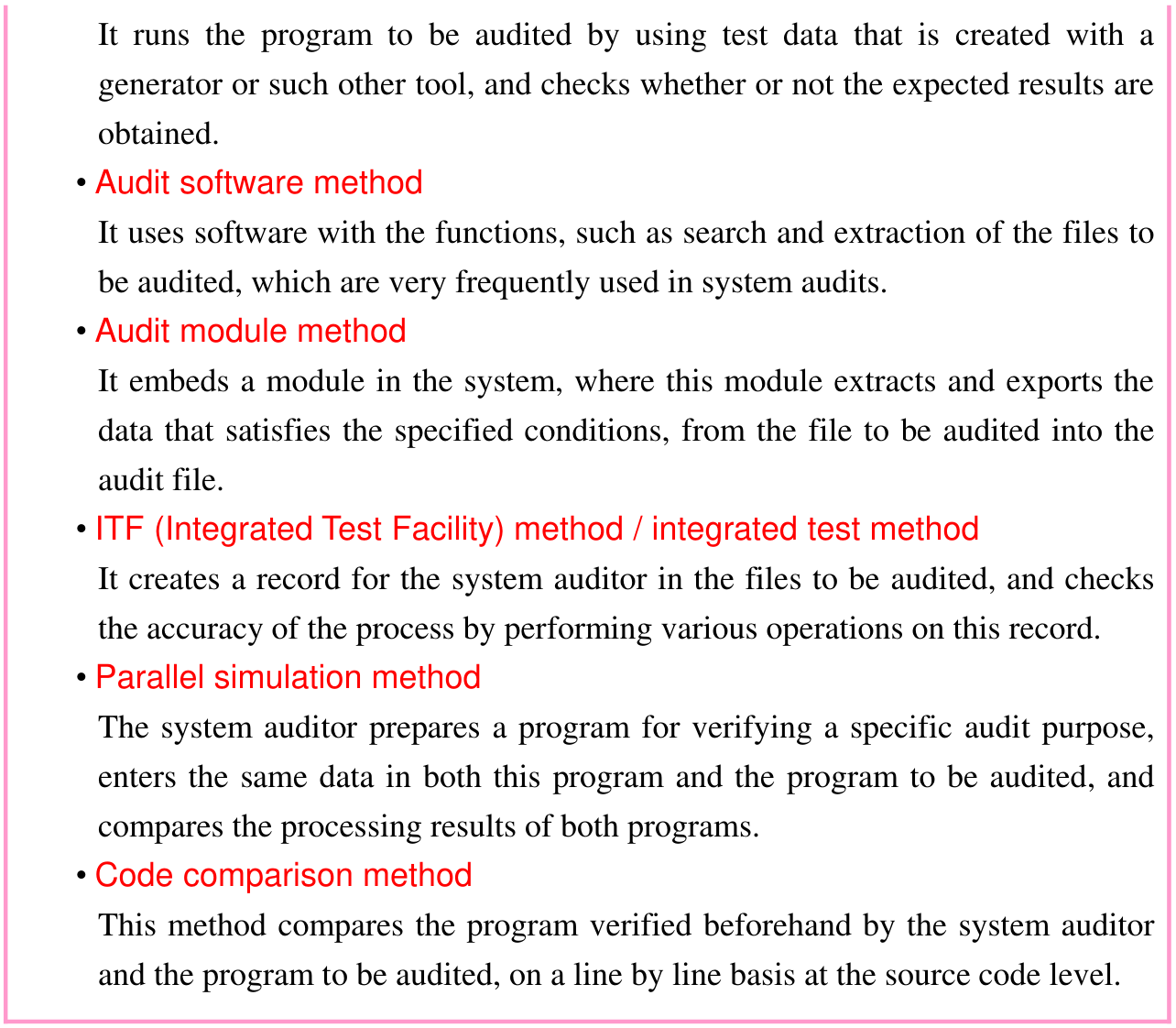
The continued box completes the test data method description, followed by audit software, audit module, ITF or integrated test, parallel simulation and code comparison methods, each with its original description.
3) Evaluation and conclusion
From the results of the preliminary audit and main audit, compatibility (whether appropriate or not) is evaluated by matching the actual state of the audit target with the purpose of the audit. Concerning evaluation and conclusion, the system auditor confirms accuracy by exchanging opinions with the audited department.
Section progress
Original chapter exercises
Original chapter exercises →New FE Textbook Vol.2 · First Edition, April 2015